Showing posts with label Video Games. Show all posts

Sunday, March 17, 2013

Whoops!


I was cautiously looking forward to the new SimCity game.  Sure, the always-online requirement was troubling, especially for a game series that’s been single player for 25 years, and most of the previews complained about the small city size, but really, how can you screw up SimCity?  
 
As it turns out, pretty easily.  While I haven’t played the new game, by all accounts the launch was horribly mismanaged, with the “always-online” requirement locking players out and even erasing entire cities.  Though forced online play was an advertised part of the game from the start, it’s an unfortunate situation when you’re paying fifty dollars to effectively lease a game from a company, a company that can refuse to grant you access to the game whenever they feel like shutting down their servers.  This created a huge fuss when Blizzard tried it with Diablo III last year, but at least Diablo III worked (eventually). 

The problem is the multiplayer angle was never right for SimCity.  Multiplayer games are generally about competition, about maxing stats and staying ahead of other players.  SimCity is a game about screwing up.  In the previous games, only an elite few could make a fully functioning metropolis.  For the rest of us, the game was about filling in the map with junk until you gave up and summoned aliens to wipe it out.  The fun of SimCity comes from the joy of unfettered creation mixed with the utter frustration of watching your creation refuse to behave as planned.    

Though for many SimCity 2000 remains the ultimate version of the game, I have the fondest memories of the original game.  My first exposure to the game came not on the PC but the Super Nintendo, and my child brain was utterly fried by the possibilities.  For kids who had grown up playing almost only side scrolling action games, those first generation Super Nintendo games were a breath of fresh air.  Sure you had traditional games like Super Mario World, but there were also outside of the box titles like Actraiser (an action game mixed with an early RTS) and SimCity.  These were the kind of games you could only dream about on the original Nintendo; games where the player actually got to design and create their own world.   


Sadly, I didn’t actually own a Super Nintendo, and spending hours constructing your own city at a friend’s house isn’t exactly the most sociable of activities, so I eventually got the game for the PC.  The original 1989 PC version and the 1991 SNES version are essentially the same game, though the SNES version has a few more bells and whistles, along with a rather clumsy control scheme.  The PC version also had cool alternate graphics options allowing you to build a medieval or wild west city, something I would love to see return.  

Though fairly simple by the standard of later SimCity games, all the gameplay basics were there from the start:  worrying about money, worrying about crime, worrying about pollution, worrying about traffic, worrying about population, and summoning monsters.  Patience, almost incomprehensible patience, was the only way to win.  Or, like me, you could just hit SHIFT+FUND to build up a huge treasury, then build until the map was full, then spend a few minutes wondering why your city was a post-apocalyptic hellscape before starting it all again.


Whereas other games are all about instant gratification, SimCity is a game of small victories and slow progress.  You can spend hours upon hours just trying to balance the budget.  Even with SimCity 4 in 2003 (the most recent game before now) the formula was basically unchanged.  A SimCity fan who fell into a coma in 1990 and woke up in 2003 (thus missing the entire run of Batman:  The Animated Series) would be able to pick up and play the newer games without a hitch.  There was something constant and familiar about SimCity.

I’m not saying that change is bad or that innovations should be avoided, but SimCity was the absolute last series that needed to be online only.  The entire premise is that the player is a mayor of unstoppable god-like powers, free to do whatever she or he wants with the world.  By limiting city size and encouraging cooperative play, it seems like Maxis has removed an essential part of what makes SimCity so much fun.  Hopefully, once all the anger over the completely botched launch fades away, players will be able to find the appeal in the underlying game. 
 
For the rest of us, it sounds like the older games may do a better, more stable job of scratching the SimCity itch.  The original game is probably free at this point, SimCity 2000 can be bought from GoG.com for $6 dollars, and SimCity 4 is on Steam for $20.  Thanks in part to the problems with the new game, they’re selling quite well.  In the next SimCity game, perhaps “SimCity 2013 Release” can be one of the optional disasters.  As long as they keep the aliens.

Wednesday, January 20, 2010

A New Way Of Telling Stories

Gaming still has a bit of a bad reputation in popular culture. As the Nintendo generation continues to age (and we are aging, let’s deal with it), and people that grew up with video games as a part of life are now becoming parents themselves, a lot of the old social stigma has fallen away. Yet the stereotype of the 30 year old virgin living in his parent’s basement playing Call of Duty has never quite left us, especially among older generations. To many, games are children’s toys, or gratuitous orgies of violence and mayhem, or simple distractions. It doesn’t help matters that, as we speak, the once beloved Nintendo is doing its damnedest to make sure that reputation sticks for all eternity.

Ironically enough, it was a recent Wii game that, through no fault of Nintendo’s, reminded me just how far beyond those old notions games have come, and how far they might still go. After playing through Silent Hill: Shattered Memories on Nintendo’s parlor trick excuse for a video game system, I am more convinced than ever that games have a place in the future of storytelling. While movies and TV simply shovel information at you, games, done right, have a way of pulling you into a world and a story that no other medium can achieve.

Don’t get me wrong. One hundred thousand dollars in film school debt should be evidence enough that I love movies. Good movies can be life changing experiences, and the best ones stay with us our whole lives, providing quotable dialogue and life lessons. Who knows how many shark attacks I’ve avoided thanks to Jaws? Video games, though, provide a much different experience, much more akin to reading a book. In movies and TV shows, the story goes on with or without you. In games and books, you play an important part in what’s going on. You react to information as it comes at you, and, in games, actually have an impact on what’s going to happen next.

Silent Hill is only one of many games that give the player an active role in an ongoing story. I could use any number of fantastic games as an example (the Gabriel Knight series is the first to pop into my head—Note to Self: Write about those games in the near future), but since I’ve played Silent Hill most recently it serves as a good benchmark. Instead of a scary action-adventure romp like previous Silent Hill games, Silent Hill on the Wii is more of an interactive psychological horror story. There’s no combat, and the only “action” is running away from things. Most of the game is spent simply exploring an abandoned city as the main character searches for his daughter.

What’s interesting about the game is the way it can change. Based on the choices you make and how you play certain parts of the game, the content can change drastically. Characters can look and act completely differently based on the “psychological profile” you build up during the game. I’ve been through twice (it’s only a 5 hour game) and there are so many differences, subtle and major, that come into play to add to the sense of uncertainly the game tries to achieve. You'll travel around to different locations in the protagonist's life, collecting bits and pieces of memories, trying desperately to get a bead on what's going on only to watch your assumptions shattered again and again. It’s like being part of a good scary story that’s different every time through—to me, that’s what games should be after. I still can’t believe such a fine piece of game making art found its way to the Wii, a system that is determined to restore games to their pre-1980s role as novel time-wasters. Though Nintendo might bitch and moan until the end of time that games are supposed to be toys for children, people aren’t buying it.

Any movie, TV show, or song is subtly affected by what the intended audience brings with them. With a book, the reader takes control of the pacing, the character voices, and sometimes even their appearance. The story forms itself in the mind’s eye as it is read, and so the reader takes an active role in the creative process. Video games have the potential to go even further down this road, blurring the line between audience and character, placing the player in an environment where their choices have a profound impact on the world around them. Best of all, it can all be experienced from the comfort of your mom’s basement.

Wait…damn it.

Wednesday, December 23, 2009

Gift: Packard Bell Computer (1996)

Finally, redemption for all the video gaming misfortunes I’d suffered over the years. I pretended that I wanted a new computer for the educational elements, because I could get online and interact with friends, or so my family could finally get ahead of the technological curve. Those were all valid concerns, but they weren’t even close to the real reason. The mid 90s was the absolute zenith of PC gaming, and I wanted to be able to play games so advanced they put even the upcoming Nintendo 64 to shame. More than anything in the world I longed to get rid of our archaic 286 computer and finally use a computer that could run games that were the envy of my friends.

I had been buying PC games for several years even though my computer had no hope of running them. They were so much more interesting and complex then Nintendo and Sega games (at that time), with big giant boxes and long instruction manuals that talked about the game world as much as how to play the game. Some even included maps and charts and other goodies that made things even more fun. But I had no way of playing them.

My family was never very tech savvy, and they refused to understand the need for a computer that could actually connect to the internet and interact with the modern world. It wasn’t until 1996 when I finally sensed my wisdom was getting though, and so by the time Christmas rolled around I was fully expecting a new computer. If I hadn’t gotten a new computer, I would have probably just taken up a sport or started dating or something—it’s incredibly difficult to be a successful nerd without a good computer. Fortunately we’ll never have know what my life would have been like had I gone down that road. For on Christmas of 1996 I became the proud owner of a new Packard Bell 200 MHZ Pentium computer. Pentium, people. That’s like a million times better than a 486.
The first game I installed was Tie Fighter, part of a “Star Wars Collection” I got that included six Star Wars games of massively varying quality, from the ludicrously awesome Tie Fighter to the abysmal Rebel Assault. Star Wars was big again at that time—the Special Editions were about to come out, and the games and novels had been coming out in force for a few years. Tie Fighter gets my vote for being the best Star Wars related product ever, movies included. Nothing for me quite captures the spirit of what those movies were all about than Tie Fighter. Before the prequels Star Wars was a crazy gritty world of heroes and scoundrels, but the best thing about Tie Fighter was that you were just an average Joe imperial pilot trying to make his way in the Empire. In addition to being a great game Tie Fighter was the quintessential pre-prequel Star Wars experience.


I had also had King’s Quest VI laying around the house for a long time, an even older game that I nevertheless experienced for the first time on Christmas of 1996. Adventure games are long dead, despite occasional articles about a “renaissance” that never quite materializes, but back in the mid 90s they were still a viable genre, and some of the best ever, like Gabriel Knight II and Grim Fandango were just coming out. King’s Quest VI was from 1992, but it felt as fresh then as any new game, and indeed it remains one of the best Sierra adventure games ever made (good future topic: Sierra adventure games.) The backgrounds are beautiful, the characters are rich, and the game has so many memorable moments, from the very first moment you wake up on the beach to the climactic journey through the Land of the Dead. The production values and ambition were greater than anything I’d ever seen on Nintendo and Sega, and the game was from 1992!

Of course, the real highlight of that Christmas was a game I’d been fantasizing about for months. I rushed out with my Christmas money to buy it the second Wal-Mart opened up, and I don’t think a year has gone by where I didn’t play it at least once ever since: Daggerfall. Daggerfall is too huge a phenomenon for me to skim over here—it requires its own discussion. Suffice to say it was the most expansive, in depth, and atmospheric RPG I had ever played, and it really opened my eyes to what a computer game could be. I had infinitely more fun reading the Daggerfall instruction manual than I ever had with the Sega 32X.
There were so many other great games, and I got to play them all in one big burst during the first few months of 1997—Warcraft, Warcraft II, Diablo, Phantasmagoria (not great so much as memorable), Under A Killing Moon, the Pandora Directive, Ultima Online, and about a dozen more. I could spend days talking about any of these games, but I’ll refrain from that for now, since this was supposed to be about my introduction to the computer age. In addition to games there was also the world of AOL. Those years were the golden age of AIM conversations and online shenanigans—programs that could force people offline, internet romances, and personal geocities websites. Just the existence of the internet was a novelty—when I discovered that the cover of one of my favorite novels was online, I printed it out just because I could.

These days a computer is really just for the internet. There are still a few great games, but most of them have moved on to the Xbox 360 or the PS3. There are no more giant boxes filled with 120 page manuals and great junk—today computer games are just console games with inferior controls and difficult installations. But back in 1996 a good computer game was the height of interactive entertainment. That was the last Christmas where I really had that old childlike sense of excitement. How could I not? After fantasizing about playing all those computer games for years, I got them all literally overnight. A Christmas where you get to play King’s Quest VI and Tie Fighter for the first time on the same day is a Christmas indeed.

Friday, December 18, 2009

Gift: Nintendo Entertainment System (1990)

This one is obvious. What kid didn’t dream of waking up on Christmas morning and finding a brand new Nintendo under the tree? Only kids who already had Nintendos, and by 1990 there were a lot of them. I was a little late to the Nintendo party. I knew a lot of people who already had one (or had the similar, lamer alternative, the Sega Master System), and I had played it casually for a long time at different people’s houses. But among my close friends, I was the only one to own a genuine NES and (very soon) a large library of games. In fact, it’s a little surprising when I look back now how quickly my bundle of Nintendo related crap accumulated. I only had it for about 18 months before I moved on to Sega Genesis, but in that short time I accumulated a disproportionate amount of games and fun.

The Nintendo was one of the very last presents I opened that Christmas. Christmas of 1990 was the Christmas of MC Hammer and the Ninja Turtles and The Simpsons, and I was fortunate enough to add a brand new Nintendo to that embarrassment of riches. It came with a note saying I had to share it with my dad, but other than the original Super Mario Brothers my dad has been unable to figure out a single video game, so I’m not sure what the purpose of the note was. Early on, my parents would play Mario in the other room after I went to bed, and I still have good memories of listening to them argue about the best way to get past King Koopa (as we called him in those days). Sometimes my dad would even come home from work excited because he had learned some new secret from a co-worker.

That phase passed quickly, however, and for the most part I had the Nintendo all to myself. Initially I spent all of my time on the three games I got that Christmas: Mario and Duck Hunt, of course, along with Teenage Mutant Ninja Turtles and Fester’s Quest. Both of the latter games have more than earned their reputation as some of the worst games on Nintendo, even though the Ninja Turtles were so popular that everyone had that stupid game. Standards of video game quality weren’t quite up to their modern standards yet, and I made do the best I could. I enjoyed Mario, but it never quite clicked for me the way it did with a lot of people; it wasn’t until I got Mario 3 a few months later that I really plunged into a Mario game. I also, to my later humiliation, loved the Zelda cartoon series, so much so that I wanted to make it into my very first live action movie, and so a snow day rental of Zelda 2 (not the original) became one of my earliest Nintendo highlights. I was always, and perhaps foolishly, interested in games with established characters and plots, hence the ownership of the terrible Ninja Turtles game.

Somehow, despite the terrible games, I became a big Nintendo fan, and, even more stunningly, my house became a Mecca for other 3rd graders seeking a chance to enjoy time with the sacred gray box. In those days we had a fourth bedroom upstairs that was almost exclusively reserved for playing Nintendo, and it became our club house. Far removed from the rest of the house, it was a place where the kids could learn and study the craft of Nintendo relatively free from adult interference. Shortly I added some new games to the repertoire
Gremlins 2 (yay!), Teenage Mutant Ninja Turtles II: The Good One, and of course Super Mario Brothers 3. The Nintendo age had truly begun.
It’s funny—there was nothing more important to me that Christmas than getting a Nintendo, and I have dozens of great, unforgettable memories associated with that thing, but when I think of that Christmas it’s the lesser presents I remember more. Like The Simpsons Sing the Blues, Gremlins 2, my Ninja Turtles Tiger handheld game (remember those?) and my MC Hammer tape. 1990 was more about all the crazy cartoon fads that were exploding in the elementary school pop-culture scene than any big gift. The more I think about it, the more I think that maybe Nintendo might not have become the phenomenon it was were it not so closely linked to all those exploding fads. There were Simpsons games, Ninja Turtles, games for just about every movie and property to come along—most of those games were terrible, but I’m sure they helped sell Nintendos as much as Mario did.

I’ve written more about 1990 than any other Christmas, probably because there were so many popular characters and TV shows swirling around back then. Only in a year as vibrant with pop culture kiddy confection could something as wondrous as a Nintendo be only one among many memorable gifts. What an awesome time to be 8 years old.

Tuesday, December 15, 2009

Gift: The Legend Of Zelda: Ocarina of Time (1998)

There’s been so much already written about this game that I almost don’t want to get into it, but since I spent an entire Christmas break playing it, I can’t ignore it. To my shock and horror many of the people writing about and remembering Ocarina of Time these days were just children when the game came out eleven years ago. It’s hard for this seasoned video game nerd to believe that there are adults out there now whose first experience with Zelda was Ocarina of Time. I was no kid when it came out. I was sixteen, almost seventeen, with a host of problems I considered very adult, and yet the game still found its way to being one of my favorite gaming experiences of all time—one of the last games that was ever quite that much fun.

You might call Christmas of 1998 my first bad Christmas. I’m not sure what made me so unhappy that day. By that point Christmas had lost a lot of its luster, and I think I would have much rather been asleep on Christmas morning than downstairs opening presents. As a kid I’d forced my parents out of bed at 6 a.m. to open presents; by 1998 they had to practically drag me out of bed at 11:30. Despite all the problems I thought I had as a teenager, life was actually relatively simple: Bed good, not-bed bad.

So I wasn’t overflowing with Christmas cheer that year. I believe I spent the day on the sofa with my hands across my chest, grudgingly opening every present as it was handed to me without so much as a nod to the rest of the family. I don’t remember desperately wanting Zelda that year, at least not enough to justify my teenage surliness, but every time I opened a box that wasn’t Zelda I got angrier and angrier. Throughout my life I was always a very well behaved, jolly child who was happy with any gift as long as I was with friends and family—I guess all my childlike selfishness finally came out that Christmas after years of hibernation. For what seemed like hours I got nothing but socks upon socks upon socks, and I got moodier and moodier and moodier. Finally, only one present was left, from my 13 year old sister. I had no hopes for it, but this story wouldn't make much sense unless it turned out to be Zelda, which of course it did.
I wish I could say my mood didn’t suddenly elevate when I saw the familiar gold box. I wish I could say that my brooding teenager vibe came from something other than desire for a Nintendo game, but that would just be dishonest. The moment I got the game, I was on cloud nine. So maybe I was still a kid.

In my defense, it’s an incredible game. It probably seems dated now, but at the time it was the most expansive adventure I had ever seen on a console—it sure blew away anything else on the Nintendo 64. For the first time Hyrule felt like a real world, with real 3D towns and cities and characters and monsters. Every area had its own unique inhabitants, from the Gorons on Death Mountain to the Gerudo Thieves in the desert. Older Zelda games had been nothing more than flat 2D maps, and while the earlier games were great, Ocarina left them all in the dust. For the first time you could jump on a horse and run across a seamless world firing arrows and jumping fences. With few exceptions, console games before this had been confined to levels, stages, and areas. Coming from those games to
Ocarina of Time was like discovering the world was round.
This game took everything that was great about older Zelda games and perfected it while adding a host of new stuff to the mix. The whole time travel gimmick was one of the game’s big selling points—it actually takes place in two different Hyrules, seven years apart. By traveling back and forth through time you can alter events in the different eras, and discovering what effect your actions can have is one of the game’s many highlights. It’s not used as often as it could have been, but it works. Mini-games also abound, from target practice to fishing to horseback riding; if anything, there’s too much to do.
Since there’s a musical instrument in the title (though I’m sure this game was the first time 99% of the audience heard of an ocarina, including me. Funny pronunciations were rampant) you’d expect music to play a huge role in the game, and you’d be right.
Ocarina of Time has some of the most memorable themes from any game I’ve ever played, and it doesn’t even included the traditional Zelda theme! You have to actually play different songs on your ocarina during the game, so they worm their way into your brain by necessity. I haven’t played the game in many years, but I still catch myself humming “Zelda’s Lullaby” (actually from A Link to the Past) or “Saria’s Song” from time to time, not to mention the great incidental and location specific music. Later on, when I watched others play the game, I noticed that they simply just jammed on the buttons when playing the songs, like they were inputting a secret code, without any effort to match the tempo. If you play the game like that, you’ve never even played it. Making music is part of the fun.
One of my best friends also got the game that Christmas, and the thought that he might get to the end before me was just unbearable. When he first called me to talk about it a few days after Christmas, we were both at the same spot. That would not stand. From then on, I devoted myself entirely to playing Zelda: Up until 4am every night, up again at 9am to play some more. By New Year’s Eve I’d beaten the game and unlocked every conceivable item and area. When school started up again and I talked to my friend, I discovered he hadn’t had the chance to play the game for a while and was still in the 3rd dungeon. I suppose I overdid it.

I think I played through the game another four or five times that year, but like everything you do more than once it got less interesting each time. But that one playthrough alone gave me more enjoyment than hundreds of other games combined. I probably say this about every game I praise here, but when a game’s that good you don’t remember playing a game, you remember being there. Few games have given me the same sense of place as
Ocarina of Time. The game has been out for eleven years now, and in all that time I’ve only met one person who had anything bad to say about it. It’s one of those rare games (or movies, or books) that gets every single thing right.
With a game that good, maybe my whiny emo-kid behavior was justified, right? Maybe all the emo-kids you see out there today just need a Nintendo 64 and
Ocarina of Time to chase the blues away. It sure doesn’t hurt.

Saturday, December 12, 2009

Gift: Sega Game Gear (1992) and Sega 32X (1994)

Sega, Sega, Sega. What happened, Sega? You could have had it all.

In 1992, Sega was poised to rule the video game industry for all time. According to their commercials, they were way cooler than Nintendo, and games like Sonic the Hedgehog 2 backed up the ads. Little did we Sega acolytes know that at the height of her power Sega was already falling victim to that fatal flaw that would lead to her destruction. But it soon became obvious to all but the most die-hard of Sega supporters: Everything Sega made that wasn’t the Genesis sucked, and sucked badly.

How naïve I was! I was overjoyed when I received the Sega Game Gear for Christmas in 1992. Some of my friends already had one, and there was no doubt it blew the Game Boy away in every conceivable area—it was bigger, it was black (which meant it was cool), it had more buttons, you could turn it into a portable TV by purchasing a simple add-on, and it was in color. Color, people. That was huge. While my Nintendo-loving friends were forced to huddle around their green-hued Game Boy, I was able to play 8-bit Game Gear games in full and glorious color.

Yet it was somehow wrong. There were some fun games for Game Gear (the Sonic games chief among them) and it initially seemed like a sound investment, but I couldn’t shake the nagging feeling that for all its superiority the Game Gear was missing something. As each new game ended up being worse than the last, it slowly dawned on me that technical superiority doesn’t mean a damn if you can produce the games to back it up. While Nintendo was releasing gems like Link’s Awakening for Game Boy, Game Gear owners had to deal with gaming miscarriages like Quest for the Shaven Yak starring Ren and Stimpy and Chakan: The Forever Man, along with a host of mediocre ports of much better Sega Genesis games. I bought a new game here and there, but my enjoyment of Game Gear didn’t last much beyond that Christmas.

But I still loved my Genesis, and my faith in Sega was not shaken. That would take an even more disastrous financial blunder, a decision so insulting, so terrible, and so misguided that it remains hated and despised by even those who once called themselves loyal Sega aficionados: The dreaded Sega CD/32X double whammy that sent the company into a (deserved) free-fall from which it never really recovered.

In an effort to prolong the Genesis' life against the technically superior (yes, I can admit that now) Super Nintendo, Sega released two add-ons designed to make the Genesis more powerful. The first, the Sega CD, hooked up to the bottom of the Genesis and let Sega fans play "CD quality" games, which meant crappy interactive movies with grainy, terrible video and non-existent gameplay. Naturally, I desperately wanted one.

The $300 Sega CD was too expensive for me, but so pure was my loyalty to Sega that when the 32X was announced at the relatively cheap price of 150 dollars, I begged my parents for a chance to “upgrade” my Sega Genesis to a 32-bit powerhouse. Let’s see those Nintendo kids talk bad about Sega now, right? It even had the first ever Star Wars game for a Sega console: Star Wars Arcade, which promised to accurately recreate the space battles from the movies in 32-bit detail. How could I lose?
By getting a 32X, that’s how. Unlike the CD, which hooked up to the bottom of the Genesis in a somewhat aesthetically pleasing manner, the 32X plugged into the cartridge slot and sat atop the Genesis like some mushroom shaped tumor. It even came with a set of metal clamps to surgically hold open the Sega Genesis slot so it could be forced inside--that's incredibly disturbing, and I wish I was making it up.

Not only was it ugly and difficult to get attached to the Genesis, but the new Star Wars game was awful. Sure, I had a lot of fun playing it for a few days around Christmas—the sound was way better than what the Genesis could normally do (though still nowhere near as good as the SNES, which, incidentally, cost less than the 32X!) and the graphics were impressive (from time to time), but that was about it. That was my big “Star Wars” Christmas, and I got plenty of enjoyable Star Wars stuff, including the movies on VHS, but the 32X will always cast a dark shadow over the whole day. 200 dollars of my parents’ money was lost forever on a crappy Star Wars game that got old after about a week. They were so mad at me that they refused to buy me another video game system from that day on.

I never got another game for the 32X, and it was quickly tossed aside in favor of the only good Sega add-on—The Sega Channel, which let you play 30 full games a month for less than the price of a Netflix subscription. It was brilliant, ahead of its time, and probably saved me hundreds of dollars on game purchases. But it was too little, too late, and Sega could never recover from the disaster that was the 32X. Better minds than mine have already filled the internet with diatribe after diatribe on the system’s failings, so I don’t need to go into detail about what an unforgivable hunk of junk it was. Suffice to say that it was an unforgivable hunk of junk.

So why is such a miserable piece of electronic afterbirth on my list of my favorite Christmas presents? As a warning, a cautionary tale to all those youngsters out there who, whether from brand loyalty or easy susceptibility to in your face advertising, might be thinking of buying a suspicious product. Even companies you trust, even companies who have provided you with hours of quality entertainment, can sell you down the river without a second’s hesitation. It’s also a lesson on the capriciousness of fate. One minute your company can be on top of the world with Sonic the Hedgehog, the next minute you’ve got a warehouse full of unsold Star Wars games; Star Wars games where a full half of the game’s expansive eight levels consist of flying around in empty space trying to shoot a certain number of TIE Fighters. It would have been boring if it wasn’t so infuriating.
I learned a valuable lesson that Christmas: Sometimes things you believe in suck. It’s a lesson that only grows more relevant as time goes by.

Why Sega? Why?

Monday, November 30, 2009

Cleansing The Holy Roman Empire of Evil

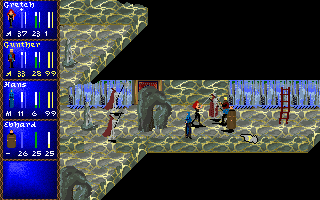
It’s starting to seem that all the computer games I write about have one thing in common: poor sales. Darklands is a 1992 RPG from Microprose that, surprise surprise, sold poorly. I can’t imagine why. It is a hardcore, party-based RPG that takes place in a historically accurate version of the Holy Roman Empire in the 15th century. The enemies are witches, pagan cultists, and greedy robber barons, with the occasional mythological creature thrown in to spice things up. Instead of magic, characters bring about miraculous events by praying to one of dozens of real-life medieval saints. To survive in Darklands, you’ll need at least one character that has a high Latin skill, and it helps to attend Mass fairly regularly, too. That’s right. This game has a Latin skill. You’d think kids would have been selling their Super Nintendos and Sega Genesises left and right to get their hands on a copy of this thing, but for some inexplicable reason it never found an audience outside of a group of hardcore nerds for whom traditional elf and wizard fantasy was “too mainstream.”
As such a nerd, I can’t get enough of this game. It’s incredibly easy for me to lose a few hours adventuring around late-medieval Germany, righting wrongs, slaying evil doers, and attending Mass. The game is totally free-form, and while there is a main plot dealing with pagan cultists trying to bring about the end of the world, it’s very easy to miss. I know how to get involved with it, but I’ve never bothered, since I’m usually too busy with all the other tasks the game throws at you. Any game with a 115 page instruction manual (complete with a 5 page bibliography) is certain to offer plenty to do.
That's not to say there aren't problems. If the setting and realistic approach don’t turn people off, then the presentation just might.
Darklands is downright archaic. For the most part, the game is a text adventure with static art to go with the menus. You’ll spend time in town earning money, talking to merchants, playing street games, talking to the bishops and counts, and performing alchemy, all through text menus. (There's also no journal system to keep track of what you've done or where you've been, so be prepared to bring paper.) The art that does exist is pretty and evocative, making the most of a 256 color palate, but seeing the same images over and over again, town after town, can get a bit repetitive. An impressive (for the time) collection of medieval music really helps out, however, and the game does its best at immersing you in the world of medieval Germany. Considering just how little the game has to work with in terms of graphics, it’s amazing it’s as evocative as it is.The huge advantage of relying so much on text is the glut of options it gives the player. Every situation gives the player four or five ways to proceed, sometimes even more. See a pagan altar? You can try to destroy it by force, call on a saint to help you, use a special potion to destroy it, rig up a mechanical device to smash it, call upon the altar’s demon and kill him, or run away in terror. There are hundreds of situations like this, each with their own choices and consequences. So many RPGs today are happy to focus on graphics while limiting the player’s ability to interact with the world. In Darklands you’ll never say “Why can’t I do it another way?” because in Darklands, there’s always another way.
In addition to the text-based elements, the game has two more sections: An overworld map, where your tiny character walks from town to town, and combat, which probably feels the most familiar to modern gamers. The game uses a very rudimentary form of the combat system found in games such as
Baldur’s Gate. You pause the action, give orders to your party, and watch them carry them out. You’ll be fighting A LOT of battles in Darklands, so mastering the old-fashioned controls is essential. It can be a little awkward—in one dungeon, it took me three keystrokes just to open a door and get everyone through, but for the most part combat works.
Unfortunately your party is limited to only four characters, while you are often swarmed with a dozen powerful enemies. What’s worse, you’ll slow down as the years pass by, and characters become pretty slow and useless by the time they reach their mid-40s. (It was the Middle Ages, fifty was ancient.) Your characters will finally reach a point where not even attending Mass can save them—they’ll need to be retired. This is where the game’s phenomenal character generation system comes in to play.

Darklands
uses a skill based, level-free system for character advancement. There are around 20 skills, ranging from the expected sword and bow skills to such Darklands specialties as woodsman, reading and writing, and of course Latin. When you create a new character, you don’t select their skills. Instead you pick their background. They can come from a noble family, a merchant family, a peasant family, or more.
After you pick the initial background, you’ll get a number of points to distribute to the various skills based on the background you pick. You then pick a career for your character—knight, nun, cleric, alchemist, merchant, thief, etc. which gives more points to distribute. The Middle Ages apparently being a fabulous time for social mobility, you can choose a new career for your character every five years, either continuing on their initial track to make them more focused, or sampling from several careers to create a jack-of-all-trades type. The trick is that every new profession you pick will age your character another five years, so you’ve got to get them out of character generation and into the game before they become too old to be effective.
Once you’ve retired a game character, you can replace them from the stable of new medieval adventurers you’ve created and carry on your quests indefinitely, gaining ever more fame and money. Essentially, the game is a medieval German version of the classic 1987 game
Pirates! The spirit and play style are very similar, Darklands just cranks everything that made Pirates! great up to 11. It’s a complicated game aimed at very narrow audience (me and about 7 people I took history with in college) but it’s worth the time it takes to get past the old-fashioned graphics and gameplay.
A few years ago
Pirates! was remade for modern PCs to excellent effect, keeping all of the game's classic features while updating the graphics and controls. I pray that someone, somewhere is working on a similar remake for Darklands. 21st century gamers need to be taught the joys of medieval history, fighting dragons, defeating cruel robber barons, and attending Mass.

Monday, October 26, 2009

"What A Horrible Night To Have A Curse"--Classic Gaming Meets Classic Monsters

And the Rest (1994-present)

After Super Castlevania IV the series took a hiatus for a few years. As a loyal Sega Genesis owner, I loved the next entry in the series, 1994’s Castlevania: Bloodlines, the first to appear for the Sega. The music and graphics were slightly behind the SNES, of course, but the game made up for it by letting you choose from two characters and amping up the gore levels to Sega standards. Even the plot tied into real world history—on the eve of World War I, an evil sorcerer revives Elizabeth Bathory, who in turn starts a plan to revive Dracula himself. The heroes, John Morris and Eric Lecarde, equipped with the classic whip and a super-deadly spear, respectively, set off across real European locations, such as the Leaning Tower of Pisa and Versailles Palace on a mission to once again put Dracula to rest. It’s chock full of typical Castlevania action, and many purists consider this the last “true” Castlevania game.

To many, the series achieved perfection with 1997’s Symphony of the Night for the original Playstation. Here the series returned to the ideas in Castlevania II and crafted a non-linear, go anywhere game filled to the brim with weapons, power ups , and unlockable secrets. This time you played not as a Belmont, but as Alucard (get it?), the super emo-goth son of Dracula (who made his first appearance in Castlevania III). Alucard could turn into a wolf, a bat, or mist, and was an all around badass. So much so, in fact, that the game is ridiculously easy. Don’t get me wrong, it’s a blast from start to finish and deserves its reputation as one of the greatest games ever made, but there’s simply no difficulty. By the time you get to the end, Alucard will be so powerful that he could brush off a nuclear war with the wave of his sword. Not even his dad Dracula can stand up to him.

Symphony of the Night is worth playing now for the cheesy voice acting alone. You’ve never heard bad acting until you hear Dracula speak the immortal line, “What is a man? A miserable little pile of secrets!” Voice acting aside, the game’s presentation is top notch, and despite my love for old school CV, if you play just one game in the series, it should probably be this one.


I am probably alone in my enjoyment of Castlevania for Nintendo 64. This was the series’ first excursion into 3D, and a lot of the jumping and fighting was indeed awkward. But the game also had a lot of fun adventure elements, the chance to fight vampires other than just Dracula, and many endings and ways to play. Running through a hedge maze while being chased by a chainsaw wielding Frankenstein’s Monster is easily worth fifty bucks, if you ask me. If you bother to check game reviews from the time the game came out, you’ll find that they’re almost universally positive, but today game writers would have you believe they hated the 3D Castlevania from day one. Not so, I’m afraid.
Chastised by the failure (imagined or otherwise) of
Castlevania 64, the game retreated to the world of the 2D handheld platforms—the Game Boy Advance and the Nintendo DS. For the last ten years, with the exception of a few mediocre PS2/X-Box games and an ill-advised fighting game for the Wii, Konami has simply copied Symphony of the Night again and again and again for the portable platforms, and the character designs have gotten farther and farther away from their Gothic horror roots. Current Castlevania “men” are designed to look prettier than any girl I’ve ever met—I understand that that’s popular in Japan, but it’s starting to get more than a little weird.

At E3 a few months ago, Konami announced an all new 3D Castlevania game for X-Box 360 and PS3, Lords of Shadow, that promises to be more than another Symphony of the Night clone. With professional voice acting, a gritty medieval setting, and a promise to take the series back to the action oriented roots of Castlevania and Super Castlevania IV, this game is certainly one to watch. (Though it could just be terrible again, resulting in another glut of Symphony of the Night clones and possibly the death of Castlevania on the mainstream consoles. So let’s hope it’s good!)

That got very lengthy, but I’ve been waiting to write about these games for a while. What better time than Halloween to recall the glory days of opening the classic silver Konami box and taking an 8-bit trip to Transylvania?

"What A Horrible Night To Have A Curse"--Classic Gaming Meets Classis Monsters

Super Castlevania IV (1991)

When I was in elementary school, fantasizing about the long distant day when the Super Nintendo would become a reality, Super Castlevania IV was one of those games that kept me up at night with anticipation. I saw pictures in magazines, but I really didn’t believe any game, on any system, could look anywhere near that good.

But it did. It may seem old-fashioned now, but when it came out in late 1991 it was a showpiece game for the Super Nintendo. Some of the extra graphical touches are a little gratuitous—I’ve yet to figure out exactly what I’m inside when the room is spinning like a barrel in the fourth level. It looks cool, but that’s about it. No matter what you think of the some of the graphical bells and whistles, there’s no question that this game is visually leaps and bounds ahead of the NES games. The transition from 8-bit to 16-bit was as revolutionary in its time as the change from 2D to 3D gaming would be a few years later, and one need look no further than Super Castlevania IV for evidence.


It remains unclear exactly what the storyline of this game was supposed to be, but most agree that it is essentially a remake and expansion of the first game. You again play as Simon Belmont on a quest to kill Dracula. This time Simon’s hair is brown both in the game and on the box, plus he’s upgraded his wardrobe to a suit of stylish black armor. For some reason, instead of leg armor he wears a very short armored skirt, but we can forgive him. I guess fighting Dracula requires a lot of flexibility. Thanks to the Super Nintendo’s power the new Simon is also several times taller than his NES incarnation. He actually looks like a human being, his animation is much improved, and he moves less like a bag of rocks. Outside of Simon the game sports great new graphical touches all over. From the ghostly horses in the background of stable level to the eerie dining tables in the first level of Dracula’s castle, the designers put in so many little flourishes that you’ll be noticing something new on every playthrough.

Like the very first Castlevania, this game is completely linear, though like Castlevania II and III some of the stages take place outside of the castle itself. If losing the freedom of Castlevania II and the choices and companions from Castlevania III seems like a step back for the series, Castlevania IV makes up for it with absolutely stellar side scrolling action. This is the only Castlevania game ever where Simon’s whip actually works like a whip instead of just a long stick. You can attack with the whip in any direction, and even, in some instances, swing from it like Indiana Jones (though why Dracula would fill his castle with objects specifically designed for whip swinging is beyond me). All this versatility makes the game slightly easier than the NES classics, but there are still plenty of opportunities for the gnashing of teeth.

Enemy design really shines in Castlevania IV as well, once again owing to the Super Nintendo’s improved capabilities. By this time it was finally possible to have giant bosses that take up the entire screen, and some of the boss monsters, like the giant golem and the twin sea serpents, are particularly memorable. I personally enjoy the bizarre creepiness of the dancing ghosts at the end of level 6. There’s something about a ghostly couple who are equally intent on dancing as they are on murdering the player that’s very effective. Only Dracula himself is a little disappointing. After so many innovative bosses, the fight with Dracula, who has essentially one form (he even gives you life, for the love of God!) is pretty anticlimactic, as is the overused “collapsing castle” ending. At least in Castlevania II and III we got a little bit of badly translated text to go with the scene.

Last but not least, special mention goes to the music. The Super Nintendo’s music chip was one of the big reasons it finally won out against the Genesis, and with the already stellar tunes of Castlevania the system really delivered. “Vampire Killer,” “Bloody Tears,” and “The Beginning” from the previous three games all make their triumphant return here, each one more fleshed out and powerful than ever before. In addition there are plenty of new tracks, each one just right for the level. The standout from this game is probably “Simon’s Theme”—it accompanies the very first level, and puts one in the mood for some cheesy Universal Monster slaying adventures.


Castlevania IV is one of the best games for Super Nintendo, but it was the end of an era. Soon the popular series would go off in a new direction once more, and these classic action games of the past would be forgotten.

To be concluded. . .

Sunday, October 25, 2009

"What A Horrible Night To Have A Curse"--Classic Gaming Meets Classic Monsters

Castlevania III: Dracula’s Curse (1990)

This game is widely, and with good cause, considered to be the greatest of the NES Castlevanias and one of the greatest NES games, period. IGN recently voted it 5th in its list of the Top 100 Nintendo Games of All Time. It’s easy to see why. This game took the series back to its level-based, side scrolling roots, then cranked that up to 11. If anything, this game is even harder than the original Castlevania; fortunately, as in Castlevania II, there are passwords to help ease the pain of failure. No longer did you have to leave your Nintendo turned on for hours to beat the game.

Instead you have to leave it turned on for hours to get through the punishing and lengthy stages. Whereas the original game had only six, Dracula’s Curse has nearly three times that many, depending on how you play the game, and they are all much, much longer than in Castlevania. Luckily, and here is where the series took another innovative turn, you don’t play through every level in every play through. After completing certain stages, you are given a choice of where to go next. This isn’t just a matter of picking which order you do the levels, like in Mega Man. By picking certain stages, you effectively block off others, and it might take as many as four times through to see all the game has to offer.

This story takes place 200 years before the original Castlevania and introduces a new member of the Belmont family, Trevor. You wouldn’t be able to tell that from looking at him, though. Trevor’s sprite is almost exactly like Simon’s from the original game. Back is the drab brown costume and brown hair, and back is the inability to jump worth a damn. But in Castlevania III you’re not limited to one character. Depending on which path through the game you choose, you might run into Syfa, a wizard, Grant, a high jumping pirate, or Alucard, the son of Dracula who would later appear in his own game, the classic Symphony of the Night for the PSX in 1997. Each of these companions had their own abilities to help make things a little easier, and since you could only have one with you at a time the feature offered even more incentive to play through the game multiple times.

And you’ll definitely want to play through the game multiple times. Everything is improved from the first game. The graphics are more intense (just check out the stained glass cathedral in the very first level) the bosses are bigger and more challenging, and the music is the best ever—so far. This is one of the most difficult games on the NES (out of the ones that are realistically possible to beat, anyway) and it took me years of trial and error to finally take down Dracula. (This time, you have to fight three of his forms!) What’s great about the NES Castlevanias is that no matter how punishingly difficult they can get, there always is a way out, and you’ll rarely feel cheated. There’re still those rare instances, of course, where you’ll throw the controller at the screen after an unavoidable bat slams you off a platform to your death.

Dracula’s Curse was a great swan song for series on the NES. It took the excellent platforming of the first game, mixed in a touch of the choose-your-own adventure feel of the second, and added a whole lot of little touches of its own to create a classic. Time would tell if the first game on Nintendo’s new Super Nintendo system could fill Castlevania III’s colossal boots.

To be continued…