 It’s starting to seem that all the computer games I write about have one thing in common: poor sales. Darklands is a 1992 RPG from Microprose that, surprise surprise, sold poorly. I can’t imagine why. It is a hardcore, party-based RPG that takes place in a historically accurate version of the Holy Roman Empire in the 15th century. The enemies are witches, pagan cultists, and greedy robber barons, with the occasional mythological creature thrown in to spice things up. Instead of magic, characters bring about miraculous events by praying to one of dozens of real-life medieval saints. To survive in Darklands, you’ll need at least one character that has a high Latin skill, and it helps to attend Mass fairly regularly, too. That’s right. This game has a Latin skill. You’d think kids would have been selling their Super Nintendos and Sega Genesises left and right to get their hands on a copy of this thing, but for some inexplicable reason it never found an audience outside of a group of hardcore nerds for whom traditional elf and wizard fantasy was “too mainstream.”
 As such a nerd, I can’t get enough of this game. It’s incredibly easy for me to lose a few hours adventuring around late-medieval Germany, righting wrongs, slaying evil doers, and attending Mass. The game is totally free-form, and while there is a main plot dealing with pagan cultists trying to bring about the end of the world, it’s very easy to miss. I know how to get involved with it, but I’ve never bothered, since I’m usually too busy with all the other tasks the game throws at you. Any game with a 115 page instruction manual (complete with a 5 page bibliography) is certain to offer plenty to do.
 That's not to say there aren't problems. If the setting and realistic approach don’t turn people off, then the presentation just might. Darklands is downright archaic. For the most part, the game is a text adventure with static art to go with the menus. You’ll spend time in town earning money, talking to merchants, playing street games, talking to the bishops and counts, and performing alchemy, all through text menus. (There's also no journal system to keep track of what you've done or where you've been, so be prepared to bring paper.) The art that does exist is pretty and evocative, making the most of a 256 color palate, but seeing the same images over and over again, town after town, can get a bit repetitive. An impressive (for the time) collection of medieval music really helps out, however, and the game does its best at immersing you in the world of medieval Germany. Considering just how little the game has to work with in terms of graphics, it’s amazing it’s as evocative as it is.
 The huge advantage of relying so much on text is the glut of options it gives the player. Every situation gives the player four or five ways to proceed, sometimes even more. See a pagan altar? You can try to destroy it by force, call on a saint to help you, use a special potion to destroy it, rig up a mechanical device to smash it, call upon the altar’s demon and kill him, or run away in terror. There are hundreds of situations like this, each with their own choices and consequences. So many RPGs today are happy to focus on graphics while limiting the player’s ability to interact with the world. In Darklands you’ll never say “Why can’t I do it another way?” because in Darklands, there’s always another way.

 In addition to the text-based elements, the game has two more sections: An overworld map, where your tiny character walks from town to town, and combat, which probably feels the most familiar to modern gamers. The game uses a very rudimentary form of the combat system found in games such as Baldur’s Gate. You pause the action, give orders to your party, and watch them carry them out. You’ll be fighting A LOT of battles in Darklands, so mastering the old-fashioned controls is essential. It can be a little awkward—in one dungeon, it took me three keystrokes just to open a door and get everyone through, but for the most part combat works.
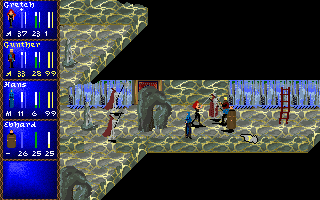 Unfortunately your party is limited to only four characters, while you are often swarmed with a dozen powerful enemies. What’s worse, you’ll slow down as the years pass by, and characters become pretty slow and useless by the time they reach their mid-40s. (It was the Middle Ages, fifty was ancient.) Your characters will finally reach a point where not even attending Mass can save them—they’ll need to be retired. This is where the game’s phenomenal character generation system comes in to play.
  Darklands uses a skill based, level-free system for character advancement. There are around 20 skills, ranging from the expected sword and bow skills to such Darklands specialties as woodsman, reading and writing, and of course Latin. When you create a new character, you don’t select their skills. Instead you pick their background. They can come from a noble family, a merchant family, a peasant family, or more.
 After you pick the initial background, you’ll get a number of points to distribute to the various skills based on the background you pick. You then pick a career for your character—knight, nun, cleric, alchemist, merchant, thief, etc. which gives more points to distribute. The Middle Ages apparently being a fabulous time for social mobility, you can choose a new career for your character every five years, either continuing on their initial track to make them more focused, or sampling from several careers to create a jack-of-all-trades type. The trick is that every new profession you pick will age your character another five years, so you’ve got to get them out of character generation and into the game before they become too old to be effective.
 Once you’ve retired a game character, you can replace them from the stable of new medieval adventurers you’ve created and carry on your quests indefinitely, gaining ever more fame and money. Essentially, the game is a medieval German version of the classic 1987 game Pirates! The spirit and play style are very similar, Darklands just cranks everything that made Pirates! great up to 11. It’s a complicated game aimed at very narrow audience (me and about 7 people I took history with in college) but it’s worth the time it takes to get past the old-fashioned graphics and gameplay.
 A few years ago Pirates! was remade for modern PCs to excellent effect, keeping all of the game's classic features while updating the graphics and controls. I pray that someone, somewhere is working on a similar remake for Darklands. 21st century gamers need to be taught the joys of medieval history, fighting dragons, defeating cruel robber barons, and attending Mass.


