For a comic strip that was so enormously popular in its time, there has been surprisingly little public discussion of Calvin & Hobbes. There are no huge web communities, no toys, no video games, no $300 million Hollywood reboots staring Shia LaBeouf. Of course, this is partly because of creator Bill Watterson's notorious refusal to merchandise his strip, but it also has to do with the medium itself. Because Calvin & Hobbes is only the comic strips themselves, it was something we all experienced individually. The world existed only in the headspace of the individual readers; like Calvin, we were free to see the strip's world any way we saw fit.
It's always surprising, then, to find out that this individual, personal part of your childhood was in fact an individual, personal part of everyone's childhood. Though we were there separately, so many of us were there together. For the generation of kids growing up in the 80s and 90s, Calvin was the comic. For many, it was how we learned to read. I was burning through Calvin & Hobbes books before I could pronounce most of the words. The strip captured a vision of childhood (and adulthood) that resonated with any kid who had ever been misunderstood, bullied, marginalized, or denied access to Cannibal Stewardess Vixens Unchained by philistine parents. Calvin & Hobbes, through gorgeous drawings and hilarious dialogue, proved as only the best art can that Hobbes is real, that the world is infinite and inviting, and that reality is optional.
Though Dear Mr. Watterson (at least from the trailer) looks to be little more than a bunch of people talking about how much they love Calvin, it may not need to be any more than that. A few years ago a book, Looking for Calvin and Hobbes, covered similar ground, but the author put too big an emphasis on finding the strip's reclusive creator. We don't need to search for Calvin & Hobbes, we have it, and getting an interview with Bill Watterson won't unlock any secrets. The best creations are bigger than their creator, and the best way to appreciate Calvin & Hobbes is not to go looking for the creator, but instead to talk to the people who loved it. It's amazing how many of us there are.
Showing posts with label Movies. Show all posts
Showing posts with label Movies. Show all posts
Saturday, March 9, 2013

Sunday, April 4, 2010
"Those Who Will Not Live By The Law...WILL DIE BY THE LAW!!!!!"
 Another Easter is upon us, though it might be tough to notice. Unlike Christmas or even Halloween, Easter has never been fully commercialized, and without a glut of TV commercials and specials (and days off work) it can come and go without much fanfare. While we can enjoy the exchange of Christmas presents or dressing up for Halloween well into adulthood, most Easter traditions are largely kid’s stuff—I see few adult Easter egg hunts. Thankfully, one Easter tradition from my childhood is still blissfully intact: The airing of cheesy biblical movies on TV.
Though it might fall by the wayside eventually, for now ABC still airs The Ten Commandments every year on the Saturday before Easter. When I was a kid, I thought a movie like this was the pinnacle of filmmaking: Huge sets, huge crowds, and huge acting. Though it all might seem a bit over the top and cheesy now, it has a charm all its own, particularly in the way it pads up the rather thin biblical story into a four hour movie.
It’s funny how much of the pop-culture impression of the biblical story of the Exodus actually comes from this movie. The Ten Commandments is so influential that the far superior animated film, The Prince of Egypt, though it claims to be based on the book of Exodus, is actually just a remake of the 1956 film, right down to the bald Yul Brynner hairstyle of Ramses II. Moses’ time in Egypt in the Bible boils down to about a paragraph. We only know that he was raised in the house of some pharaoh and is exiled after killing a slave master. The movie, however, makes Moses the adopted younger brother of Ramses II and spends a lot of time on the shirtless Charlton Heston’s role as prince of Egypt.
A highlight of the film is Anne Baxter as the sultry queen Nefretiri, a beautiful testament just how much 1950s America hated women. In the Biblical story, the Pharaoh is actually pretty eager to let the Hebrews go once Moses starts pestering him, but every time he tries God hardens his heart so God can show off with more plagues. The God in the story’s purpose is to show how powerful he is, not to free the Hebrew slaves. They’re simply an accessory to his display of machismo. Naturally, a realistic depiction of the story would never fly with middle American Christians of the 1950s, so instead of God hardening Pharaoh’s heart against the Hebrews, the work is done by his scheming wife Nefretiri.
 Indeed, without Anne Baxter’s feminine meddling, the whole Hebrew slavery crisis might have blown over without a lot of trouble. Pharaoh would have let Moses and the slaves go before it ever came to murdering the firstborn sons, and he might have gone on to rule a successful kingdom as an equal partner with the Hebrews and many other races. Instead the evil Nefretiri manipulates poor Ramses at every turn. In one memorable effort to stir Ramses against Moses and the Hebrews, she rubs Ramses' face in the fact that she threw herself at Moses. "All that you wanted from me, he would not even take!" she sneers. That's just cold.
 The lesson, for all the would be pharaohs or Hebrew messiahs out there, is simple: Never listen to women—they’re evil monsters who make a mockery of the very will of God. Audiences of the era weren't willing to accept a scheming, self-involved, and cruel God and the theological implications of such a deity, but a scheming, self-involved, and cruel woman? That's no problem.
 I can’t leave this movie without mentioning the line so silly that it made it to the title of this post. If you thought ridiculous action hero lines originated with the Stallone and Van Damme films of the 1980s, you’ve obviously never seen Charlton Heston literally murder a crowd of apostate Hebrews with the Ten Commandments. There are few things more entertaining than watching Charlton Heston, in a ridiculous beard, raise the tablets above his head and shout out “Those who will not live by the law…” (Pause for dramatic emphasis) “…WILL DIE BY THE LAW!!” before throwing the Ten Commandments into the crowd. Never mind that it makes no sense. Never mind that it’s a complete twisting of both Jewish and Christian religious philosophy. I can’t think of a better phrase to utter when preparing to murder a group of people with a copy of a law code.
  My other favorite Hollywood Easter Epic is 1961’s King of Kings, starring Captain Christopher Pike as Jesus. Though it’s less famous, I think this movie is actually a good bit better than The Ten Commandments. It’s tough to stay true to the Biblical story of Jesus (which unlike The Ten Commandments, King of Kings actually makes an effort to do) and keep things interesting. The guy basically walks around talking for three years and then has a pretty hectic final week. King of Kings makes up for this by providing a (wildly historically inaccurate) depiction of the socio-political climate during the time in which Jesus lived. So while Jeffery Hunter’s Jesus does little more than walk around speechifying in a deep and powerful voice, we get scheming politicians, lots of background on the Roman Empire and the occupation of Judea, and actual battle scenes between the Romans and Jewish rebels. That’s right: Battle scenes in a movie about Jesus, decades before Mel Gibson ever thought of picking up a camera.
 Special mention needs to be made of young Brigid Bazlen's performance as Salome. She brings an evil malevolence to the spoiled palace brat. When asked why she wants the head of John the Baptist, she replies simply “I want to look at it” in a voice so haughty and matter of fact that it becomes chilling. It’s easy to believe that this girl would derive pleasure from looking at a severed head. More importantly, her seductive dance to convince King Herod to give her the head showed just how much sex you could get away with if you were willing to creatively push the bounds of the old Motion Picture Production Code. There’s nothing as titillating as actual nudity, and nothing overt, but just by dancing around in a gold bikini Salome proved now and forever that sexiness is all about attitude.
 There’s a lot more I could write about both of these movies, so perhaps I’ll write a full discussion of them at some time in the future. In the meantime, as this particular Easter winds down, I’ll leave you with the excellent main title music from King of Kings. Nothing sums up the spirit of Easter more than this bombastic composition from the golden age of Hollywood epics. It's too bad they don't make movies like these anymore--the world could always use a little more over the top earnestness.
 Tuesday, February 2, 2010
Congrats Ferngully II !!
My feelings about the Oscar noms are a bit mixed this time around. Last year I thought it was ridiculous that The Dark Knight wasn't nominated, so to ameliorate concerns like mine the Academy doubled the number of nominations from five to ten. That translates to five movies that would have been nominated anyway (Up in the Air, Precious, The Hurt Locker, A Serious Man, and An Education--remember how much fun we all had seeing those with our friends?) and five "bonus" movies (Inglorious Basterds, Avatar, Up, District 9, and The Blind Side--really, The Blind Side? Okay.)
By my count, Avatar and District 9 are only the 3rd and 4th sci-fi films ever to be nominated, if we stretch and count Star Wars and E.T. as science fiction. While some of those latter nominees are obvious pandering so that the telecast gets higher ratings (Blind Side, I'm looking in your direction), it's great to see the nomination lists expanding to included movies that audiences actually saw. My own favorite is easily District 9, though if there was a category for "Best Use of a David Bowie Song" (and why in God's name isn't there?) I'd go with Inglorious Basterds all the way.
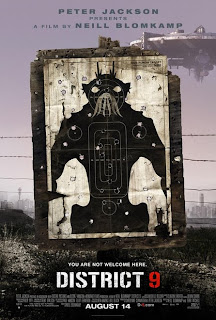 District 9 is proof that there is tons of creativity still out there in the film industry. I was too busy to blog about it when it came out, but trust me, I was through the roof for several days. Ditto Inglorious Basterds, but it was more zany than serious. Sure, District 9 was zany, but there was real emotional and intellectual depth there as well.
Avatar and Up sit less well with me--they're both great movies, but there's not a lot of originality there compared to some of the others. Up shouldn't be nominated for Best Picture and Best Animated Feature. I hate to say it, but Pixar films are starting to feel a little rote to me--Up was just a very touching short film about a couple growing up and growing old together accompanied by a fun but silly adventure that was nothing special. Coraline was, for me, a more inventive and exciting animated movie, and The Secret of Kells, so far seen only by the makers of The Secret of Kells, looks like nothing I've ever seen before. It's too bad most of us won't get to see it until March. (Maybe that's just the medieval history geek in me talking.) I say this with love, but Pixar films are starting to look too much like committee filmmaking to me--a little too neat, a little too predictable.
And Avatar? Good old Avatar. Where would we be without you? It's about to topple Titanic, yet it isn't half the cultural phenomenon that movie was. I can't say it's a bad movie, or that I didn't enjoy it, but it's one of the most predictable movies out there right now. (So was Titanic, I guess, but that was my generation's predictable James Cameron blockbuster!) Technically it's a masterpiece, but the story never gets anywhere beyond Dances with Smurfs. Again, it's a great movie, but I think the money and accolades it's raking up are a little excessive.
As for the others, well, I guess I need to see more movies, but movies about things that could just happen in real life never excites me the way fantasy nonsense does. So I haven't see the other five. Maybe I should. Hmm...
 How about those Grammys, though? Lots of great performances there. That crazy Lady Gaga, right? You just never know what she's going to do next.
By my count, Avatar and District 9 are only the 3rd and 4th sci-fi films ever to be nominated, if we stretch and count Star Wars and E.T. as science fiction. While some of those latter nominees are obvious pandering so that the telecast gets higher ratings (Blind Side, I'm looking in your direction), it's great to see the nomination lists expanding to included movies that audiences actually saw. My own favorite is easily District 9, though if there was a category for "Best Use of a David Bowie Song" (and why in God's name isn't there?) I'd go with Inglorious Basterds all the way.
 District 9 is proof that there is tons of creativity still out there in the film industry. I was too busy to blog about it when it came out, but trust me, I was through the roof for several days. Ditto Inglorious Basterds, but it was more zany than serious. Sure, District 9 was zany, but there was real emotional and intellectual depth there as well.
 Avatar and Up sit less well with me--they're both great movies, but there's not a lot of originality there compared to some of the others. Up shouldn't be nominated for Best Picture and Best Animated Feature. I hate to say it, but Pixar films are starting to feel a little rote to me--Up was just a very touching short film about a couple growing up and growing old together accompanied by a fun but silly adventure that was nothing special. Coraline was, for me, a more inventive and exciting animated movie, and The Secret of Kells, so far seen only by the makers of The Secret of Kells, looks like nothing I've ever seen before. It's too bad most of us won't get to see it until March. (Maybe that's just the medieval history geek in me talking.) I say this with love, but Pixar films are starting to look too much like committee filmmaking to me--a little too neat, a little too predictable.
And Avatar? Good old Avatar. Where would we be without you? It's about to topple Titanic, yet it isn't half the cultural phenomenon that movie was. I can't say it's a bad movie, or that I didn't enjoy it, but it's one of the most predictable movies out there right now. (So was Titanic, I guess, but that was my generation's predictable James Cameron blockbuster!) Technically it's a masterpiece, but the story never gets anywhere beyond Dances with Smurfs. Again, it's a great movie, but I think the money and accolades it's raking up are a little excessive.
As for the others, well, I guess I need to see more movies, but movies about things that could just happen in real life never excites me the way fantasy nonsense does. So I haven't see the other five. Maybe I should. Hmm...
 How about those Grammys, though? Lots of great performances there. That crazy Lady Gaga, right? You just never know what she's going to do next.
Monday, December 7, 2009
Gift: Gizmo (1985) & Gremlins 2: The New Batch VHS (1990)
 NOTE: I’m cheating a little with this post. Although the Christmas presents being discussed are a plastic Gizmo action figure and Gremlins 2 on VHS, it being Christmas I just can’t pass up the chance to talk about the original Gremlins film, which, sadly, I never received as a Christmas present.
 In the weeks leading up to Christmas of 1990, I must have watched Gremlins 2 roughly 40 times. Not Gremlins, the movie that takes place at Christmas and has a lot to do with the holiday. No. Gremlins 2, a series of madcap oddities that has very little bearing on any real life holidays, or on real life in general. I’m not even sure how I watched it, since I didn’t actually OWN Gremlins 2 until my sister gave it to me for Christmas that year. My only guess is that I rented it, then cleverly used our VHS camcorder to record a copy onto a blank tape, thus driving the first nail into the coffin of the home movie rental industry (Sorry, Blockbuster. You were fun while you lasted).
Whatever caused this sudden fascination with Gremlins lore, the movie prompted me to go down to the basement to dig up a long forgotten Christmas present from 1985: A tiny plastic Gizmo action figure. Gizmo had been given to me as a present by one of our neighbors along with some puffy Gremlins stickers, though at the time I was much more interested in He-Man. By 1990 Gizmo was a little worse for wear—some of the paint had chipped away or faded, his distinctive brown and white fur was by then mostly white. Nevertheless, from that moment on, Gizmo and I became constant companions. When it came to light that my friend Jon also owned a similarly neglected 80s Gizmo (his was actually a stuffed animal!) the mogwai adventures began in earnest.
 I’m not sure what it was about Gremlins 2 that appealed to me. It certainly doesn’t stand the test of time. Except maybe for that scene where Gizmo dances in the lab. And Christopher Lee is fun as the mad scientist. And the Spider Gremlin is crazy. Oh, and that Brain Gremlin—I still like listening to that guy. So fine, I can’t do it! I can’t sit here in my film school snobbery and pretend I don’t still think both Gremlins movies are absolutely awesome. They just are, okay?
My parents forbade me to see Gremlins until after Christmas that year, because it revealed (spoiler alert!) the fact that Santa Claus wasn’t real during Kate’s terrible story about her father dying on Christmas Eve. (Though since nowadays a kid can find out Santa is a myth simply by typing his name into Wikipedia, I wonder how long that particular tradition will last?) When I did finally see the original film, I loved it just as much as Gremlins 2.
 And so the Gremlins movies became a somewhat warped part of my Christmas memories. I still think of the song "Christmas (Baby Please Come Home)" as “the Gremlins song” and get warm memories of making hot chocolate every time I see that Gremlin get burned alive in the microwave. Watching it again recently, I noticed just how much the production design nails the feeling of Christmas in the 80s. There’s the Christmas tree lot, the small town decorations, a Montgomery Ward department store (yes, there was once such a thing) all decked out for Christmas, the record player spinning Johnny Mathis’ “Do You Hear What I Hear?”, even a cardboard box in the corner of the Peltzer house filled with wrapping paper. A big part of the movie’s nostalgia appeal now is just how much it is a product of its time. (There’s even a part for Judge Reinhold.)
 All nostalgia aside, a bunch of tiny creatures with an apparently inborn knowledge of pop culture creating mischief is just exactly the type of thing that appeals to a third grade boy. Gremlins is a dark, weird movie that would have a hard time getting made today. There’s an underlying pessimism that Hollywood doesn’t usually go for: Long sequences are devoted simply to the gremlins running amok and causing chaos. They even kill Santa Claus! Most movies would have the hero rescue the town from chaos with minimal loss of life—in Gremlins people are (presumably) killed left and right before the gremlins are finally stopped. It’s a movie that indulges in its malevolence without shame (though apparently the original concept was even darker and more violent) and that’s part of its charm. It’s a quintessential part, not just of my childhood, but of the childhoods of most of us who were kids in the 1980s.
Plastic Gizmo still lives on my nightstand at my parent’s house, serving as a silent reminder to my crazy Gremlins phase nineteen Christmases ago. During my first trip home from California for Christmas I happened to flip on Spike TV at 1am and found both Gremlins movies on in all their splendor. Back in the familiar cold weather of the east coast it was easy to sit in bed and enjoy the wonderful feeling of nostalgia and Christmas cheer that can only come with watching hordes of animatronic monsters torture and murder innocent people.
Wednesday, November 11, 2009
Clash Of The OH MY GOD MY FACE JUST EXPLODED!!
As a huge fan of the original Clash of the Titans movie (I was scared of Medusa until I was 21) I've been somewhat anxious about the remake. It'll be cool to see all the monsters updated with 21st Century technology, and Liam Neeson as Zeus is a safe bet, but do we really need remakes of everything? "Remake" is generally a euphemism for "god-awful cinematic abortion." Can you improve on the primitive handcrafted charm of Ray Harryhausen's stop motion creatures? No, you can't, but you can make it bigger, louder, and faster. Behold the new trailer:
Did you feel your head exploding? Now I love Greek Mythology, and I'm a bit of a sucker for these high octane, explosion driven, hard rock trailers, so I will probably see this. On the other hand, I have no idea what I just saw. There was Medusa and a giant scorpion, then I think I fugued out for a few seconds due the bombardment of images and music. There's no hint at all about what the characters or plot might be like. It's either incredibly awesome or incredibly stupid. What it reminds me of most is being 5 years old, playing an Ozzy Osbourne record, and putting my He-Man figures through similar hyperactive adventures. Is that good? I have no idea. My brain has melted.
Did you feel your head exploding? Now I love Greek Mythology, and I'm a bit of a sucker for these high octane, explosion driven, hard rock trailers, so I will probably see this. On the other hand, I have no idea what I just saw. There was Medusa and a giant scorpion, then I think I fugued out for a few seconds due the bombardment of images and music. There's no hint at all about what the characters or plot might be like. It's either incredibly awesome or incredibly stupid. What it reminds me of most is being 5 years old, playing an Ozzy Osbourne record, and putting my He-Man figures through similar hyperactive adventures. Is that good? I have no idea. My brain has melted.
Monday, November 2, 2009
This Is It
 This weekend I decided to buy a ridiculously overpriced Arclight movie ticket and see Michael Jackson’s This Is It. I was a little surprised at all the positive buzz the movie was generating. Nobody loved to kick Michael Jackson more than the press. It turns out that the movie is no great revelatory experience, nor even an emotional farewell to the man. It is, on the other hand, a fantastic and energetic concert film and a good answer to anyone who will ever ask the question of why Michael Jackson meant so much to so many people.
 If you like Michael Jackson’s music, you owe it to yourself to hear it pumped out of a great theatrical sound system. Michael’s voice might be a little rough around the edges, but he can still belt it out when he wants to. All of Michael’s biggest hits are here, and I doubt anyone will be complaining that their favorite wasn't included. Unfortunately the audience I saw the film with was incredibly quiet and reserved, but I can imagine that seeing this with the right group of people would be almost as fun as going to the real concert.
Even at age fifty, Michael could still move. He’s so skinny that some of the steps have a weird, puppet like quality to them, but after watching this movie there can be no question that he was one of the best dancers of the 20th century and one of the greatest entertainers of all time. Seeing him nailing the "Thriller" or "Beat It" moves 25 years later is a spectacle indeed.
Some of the set pieces and movies made for the different songs are so over the top that you can’t help but giggle, but like Bram Stoker’s Dracula they’re over the top in the best possible way. If your idea of a good action movie is seeing Michael Jackson in a film noir shootout with Humphrey Bogart (and whose isn’t?) then this concert would have been your cup of tea. Even my dull audience cheered and laughed when the film revealed how Michael would have emerged in the “Thriller” performance. It’s deliciously campy and entirely Michael Jackson.
While the performances were entertaining, what I enjoyed most was the limited glimpses the film gave of Michael at work, tweaking the show and talking to the dancers and musicians. The movie shows Michael Jackson entirely in his element, and one gets the sense (fostered by the estate, let us not forget) that he was a master craftsman and consummate perfectionist. He has opinions on the dancing, the special effects, the lighting; even the tempo of “The Way You Make Me Feel” comes under intense scrutiny. After years of knowing Michael Jackson the freak show, it’s enlightening to see him here as the talented musician and artist he always was.
It’s likely that such a perfectionist would never have wanted these rough, unfinished performances to see the light of day. However, in showing the genesis of the concert that would have been, the film helps us see past the media circus that surrounded Michael’s life and death and get a glimpse of the musical genius underneath. We don’t get any tawdry glimpses of Michael’s private life for our tabloid obsessed culture, but in showing him at work we probably get closer to knowing him than we ever could with a straight up biography. Michael Jackson was about music, dancing, and putting on a hell of a show. The man on stage was the real thing, the freaky man-child just another illusion.
If not for This Is It, Michael Jackson’s last major public appearance would have been the child molestation trial. I’d say the movie is a much better way to go out.
Wednesday, October 28, 2009
"We've All Become God's Madmen"
 Dracula and movies were born out of the same world. The novel came out in 1897, just as moving pictures were attracting crowds at fairs and exhibitions all over Europe and America. Given their common background it's no surprise that the legendary vampire has been the subject of countless films since Nosferatu first appeared in 1922. Bram Stoker’s Dracula is the first and only movie to openly acknowledge this relationship with lots of creative visual effects and nods to the film industry of yesteryear. Though this movie was probably a big part in the “emo-ization” of vampires, I love it all the same. Sometimes the crazy story of love and Dracula’s on-again off-again relationship with God really hits home for me, other times I have to laugh the whole thing off. But however I’m feeling about the story (or lack thereof) at any particular moment, I will always love this movie as a great achievement in visual filmmaking.
I seem to recall a lot of marketing hoopla around this movie when it first came out in November of 1992, but at the time I was more interested in Aladdin and Home Alone 2: Lost in New York. But Dracula provided excellent adult counter programming for that holiday season and did pretty good business at the box office. In my adolescent years boys were always watching it at sleepovers thanks to some generous nude scenes, but I missed it during those years, too. I only finally saw it when I was a junior in high school, after finding it in a VHS bargain bin a few days after Halloween. I was going through a period of life at the moment when a big Gothic love story was right up my alley, plus I’ve always been a huge history buff, so when I finally popped the movie into the VCR and saw the cross tumble from the roof of Hagia Sofia as the Turks conquered Constantinople, it was love at first sight.
 This movie is over the top in every way possible, and that only makes it better. In the first four minutes alone you get a Turkish invasion of Romania, a puppet-show battle scene, shots of brutal impalement, a gorgeous shot of Dracula’s bride plunging what appears to be a million feet to her death in the river, statues crying bloody tears, and finally a giant explosion of blood. This movie uses every cinematic trick in the book to create an experience unlike any other.
When movies first started they owed as much to magicians as to actors and directors; some of the earliest film makers were also professional magicians. They saw the medium as a way to expand on the visual illusions they employed in their magic acts, and thus special effects were born. Bram Stoker’s Dracula indulges in these old school effects with fiendish relish, giving the film an antiquated feeling that perfectly fits with the Dracula storyline. It’s almost as if you’re watching an elaborate Victorian era carnival attraction whirl to life with music, bells, and an organ grinder’s monkey. Almost every effect is done live on set, from the aforementioned death of Princess Elisabeta to Jonathan Harker’s carriage ride to Dracula’s castle; even the multitudinous explosions of blood are all happening for real. There’s not a single “location” used in this movie—every leaf, every waterway, every castle and manor house is constructed on a soundstage, allowing the creators to preserve that old-school cinema look.
 The story of Dracula is well known enough that I won’t go into it here. What the movie adds to an otherwise faithful adaptation of the book is a love story between Dracula and Mina. I still don’t quite understand whether Mina is meant to be the reincarnation of Dracula’s dead wife, or just look like her enough that the resemblance shocks his soul towards salvation, but like I’ve said the story is really a moot point. Like the book, the best part of the story is Jonathan Harker’s journey to Dracula’s castle in Romania. After that, the book descends sharply into Victorian heroic clichés as Dracula sneaks around London, but the movie keeps on wowing us with new locations, special effects, and montages. The sequence in the final third of the film, clearly modeled after the successful montage that concluded The Godfather, is equally entertaining and a whole lot more fun. On one hand, you have the marriage of Jonathan and Mina Harker in a beautiful Eastern Orthodox ceremony, and, at the same time, poor Lucy Westenra’s neck being torn open by wolf-Dracula. It’s so over the top that in any other movie it might make you laugh, but in this film it’s perfect.
 But this movie isn’t about the story, it’s about visuals and raw emotions. Gary Oldman’s performance is so tortured and sinister without creeping into parody that he carries the whole film on his shoulders. We feel for Dracula not because the story gives us a lot of reason to, but because Oldman infuses the character with such a sadness and sense of loss. His expressions and mannerisms are perfect for a man who has been at war with God for 400 years, conveying all the anger, hurt, and betrayal that would fill such a life. Is Gary Oldman the best Dracula ever? I guess that's debatable (though if you argued he wasn't, I think you'd lose the debate.) He is unarguably the best actor ever to play Dracula, so it only stands to reason that he brings far more to the part than any actor before him. If he hasn't replaced Bela Lugosi yet as the definitive image of Dracula, he sure should.
  The other actors are all fine. Winona Ryder makes a suitably naïve Mina, and Sadie Frost is fun as the vampire-in-waiting Lucy. Anthony Hopkins really seems to find the fun in Van Helsing, and plays him as a man far crazier than Dracula. In the old Dracula movies Van Helsing was always rather stern and humorless—Hopkin’s makes him into a wild eccentric with a twisted sense of humor. Sorry Hugh Jackman, but this Van Helsing has you far outclassed.
 And then there’s Keanu Reeves. Sweet, lovable Keanu. His performance in this film might be one of the worst ever recorded. From the moment he utters his first line you’ll be in stitches. It’s as if he was a foreign actor trained to read English for the first time just for this film. He suffers through the only slightly archaic dialogue like it was completely unknown to him, and seeing his bizarre reactions and truly terrible accent is a sheer delight. He’s so out of place, just looking at him is funny. In one scene near the beginning of the film, Mina types in her diary while looking at a framed photo of her Jonathan. It’s not supposed to be funny, but I dare you to look at a 19th century photograph of Ted Theodore Logan wearing period clothes and a blank, emotionless expression and not crack a smile. Keanu Reeves’ performance in this film ranks right up there with Coppola’s other casting disaster, Sophia Coppola in Godfather III, but this one is a million times funnier. Coppola couldn’t have gotten it more wrong if he’d cast an anteater.
But despite that rather gigantic fault the movie is amazing. It’s easily in my top ten of all time, for sheer audacity if nothing else. I know I’ve bad mouthed the story from time to time, but there are definitely days when it does work for me. It’s a story told in images and emotions rather than words, but if you let it wash over you it can raise a lot of questions about God and man and forgiveness and sin and evil. God definitely exists in Dracula’s world, and we’re left with the question of why a divine being would allow Dracula to live so far outside of God’s mercy and allow all the evil Dracula causes. Is it just to teach him a lesson? Or is the movie essentially a retelling of the prodigal son story, but with more blood and vampires? Or is it all about the redemptive power of love, divine or otherwise? It was honestly the hopeless love story element that made this movie so appealing to me in high school. There are moments in everyone’s life when a love so powerful it can survive the grave seems like a mighty entertaining notion, and the romantic sucker in me still enjoys watching Gary Oldman’s Dracula pine away for his Mina.
 I’ve watched this movie at least once during the fall for over ten years now—it’s become an essential part of the Halloween season. This is the movie that turned Dracula into a sympathetic monster and unfortunately started vampires on their journey to harmless if sensual romantic leading men. But Bram Stoker’s Dracula still has it all—creepy tombs, haunted castles, obsessive love, a vengeful God, and oodles of impressive special effects and gorgeous cinematography. This is Gothic horror done to absolute perfection.
See it. See it now.
Saturday, October 3, 2009
The Disney Halloween Specials
Back in the 80s Halloween meant, among other things, lots of Halloween specials on TV. One I made sure to catch every year was A Disney Halloween. It was on in the background at Halloween parties, at Cub Scout meetings as we stuffed scarecrows to decorate our front porches, and after coming home from a night of Trick-or-Treat.
After doing a bit of research, I discovered that when I think of A Disney Halloween, I’m actually remembering bits and pieces of three different specials: Disney’s Halloween Hall O’ Fame, Disney’s Halloween Treat, and A Disney Halloween. A Disney Halloween was the longest, and more or less incorporated all the material from the other two, so for the sake of convenience I’ll use it here to refer to all three shows. Essentially the show was a compilation of a whole bunch of scary moments in Disney shorts and movies from the 1930s all the way up to the 1980s. In an era before most of these movies were easily available on VHS, it was my first exposure to a lot of the classic Disney movies: The Sword in the Stone, Peter Pan, Snow White, The Aristocats, and many others.
Watching these specials now, it’s fun to see how freaky and weird a lot of these old cartoons were. In one episode, for instance, Donald Duck takes gleeful, sadistic pleasure in handing out firecrackers to his own nephews for Trick-or-Treat. How they survived such reckless abuse is far beyond me, but in this particular cartoon they get back at Donald through the help of a devious witch named Hazel and cheerful pop-swing music.
In another cartoon Pluto is condemned to death by a council of vicious cats (who live in a giant stone cat head not at all unlike the Cave of Wonders in Aladdin). After being found guilty, Pluto is nearly burned alive by demonic, pitchfork wielding felines before waking from the dream. I’m glad to see children’s programming that’s not afraid to be so out there. I could be wrong, since I'm looking at it from an adult's eyes, but I feel like kid's entertainment has gotten tamer over the years.
But I didn’t watch the specials for the weird 40s cartoons, or even the clips of Disney villains through the years. What I looked forward to the most were the two segments that scared my Kindergarten mind the worst: The Legend of Sleepy Hollow and Night on Bald Mountain.
I’ll admit that these days Sleepy Hollow feels a little tame. The final chase with Ichabod and the horseman is still thrilling. (The TV specials tended to cut out the rather grim ending of the tale where Ichabod vanishes forever, perhaps spirited away to hell by the horseman). Disney’s Horseman is clearly supernatural. No matter how many times my parents tried to calm me by insisting the Headless Horseman was just Brom Bones in disguise, I didn’t believe it then, and I don’t believe it now. The Headless Horseman is real, damn it!
The rest of the segment hasn’t aged well; most of the time it has nothing to do with the Horseman or the actual “legend” of Sleepy Hollow. Instead we get the chipper voice of Bing Crosby as our narrator and several 1940s era boogie-woogie music numbers that blunt a lot of the terror. It’s hard to be frightened by the Headless Horseman when we learn about him through a jaunty Bing Crosby sing-along.
Night on Bald Mountain, on the other hand, remains just as beautiful, frightening, and eerie as it did when I first watched it. Originally the climax to Disney’s Fantasia, I was first exposed to the segment on A Disney Halloween, and while other kids found it boring, stupid, or slow (criticisms which are unfairly lobbed at the whole of Fantasia to this day) I was transfixed. The animation is phenomenal—I’d say it’s one of the most beautiful hand drawn shorts ever: from the ethereal movements of the ghosts to the spastic flight of the harpies and the impressive, powerful movements of Chernabog atop the mountain, the segment pushed the boundariess of what cartoon animation had been up to that point.
Unlike so many of the other cartoons, there are no heroes in Night on Bald Mountain (described as “the world’s first Halloween party” by the show’s narrator). There is nothing to stand up against the evil of the demon Chernabog. Indeed, he has this night, and presumably every night, free to do what he wants, to raise the dead and cavort with flaming demons and flying harpies without a soul to oppose him. With power like that at his disposal, what earthly force could stop him?
In Fantasia, Chernabog is defeated at dawn by the ringing of the church bell and horrible night of Bald Mountain gives way to the gorgeous Ave Maria sequence. In the Disney Halloween specials, oddly enough, they would cut away before Chernabog’s defeat, leaving him in power on Bald Mountain and presumably prepared to destroy the town and the world. As a kid who was already plenty afraid of the night, it gave me the sense that somewhere in the world something like this could happen unchecked—that the night brought on things so frightening and so otherworldly that it was never a good idea to venture too far from home after dark. Who knew which of the mountains I could see from by bedroom was home to a terrible demon and the dance of the dead?
And while I no longer believe there are mountains where demons dance to classical music, Night on Bald Mountain still reminds me of the days when I did. From that beautiful nightmare to Huey, Dewey, and Louie’s quest for candy, there’s something about A Disney Halloween that perfectly captures the fun and fright of Halloween in the 1980s for those of us who were there. I wonder what the kids are watching now?
After doing a bit of research, I discovered that when I think of A Disney Halloween, I’m actually remembering bits and pieces of three different specials: Disney’s Halloween Hall O’ Fame, Disney’s Halloween Treat, and A Disney Halloween. A Disney Halloween was the longest, and more or less incorporated all the material from the other two, so for the sake of convenience I’ll use it here to refer to all three shows. Essentially the show was a compilation of a whole bunch of scary moments in Disney shorts and movies from the 1930s all the way up to the 1980s. In an era before most of these movies were easily available on VHS, it was my first exposure to a lot of the classic Disney movies: The Sword in the Stone, Peter Pan, Snow White, The Aristocats, and many others.
Watching these specials now, it’s fun to see how freaky and weird a lot of these old cartoons were. In one episode, for instance, Donald Duck takes gleeful, sadistic pleasure in handing out firecrackers to his own nephews for Trick-or-Treat. How they survived such reckless abuse is far beyond me, but in this particular cartoon they get back at Donald through the help of a devious witch named Hazel and cheerful pop-swing music.
In another cartoon Pluto is condemned to death by a council of vicious cats (who live in a giant stone cat head not at all unlike the Cave of Wonders in Aladdin). After being found guilty, Pluto is nearly burned alive by demonic, pitchfork wielding felines before waking from the dream. I’m glad to see children’s programming that’s not afraid to be so out there. I could be wrong, since I'm looking at it from an adult's eyes, but I feel like kid's entertainment has gotten tamer over the years.
But I didn’t watch the specials for the weird 40s cartoons, or even the clips of Disney villains through the years. What I looked forward to the most were the two segments that scared my Kindergarten mind the worst: The Legend of Sleepy Hollow and Night on Bald Mountain.
I’ll admit that these days Sleepy Hollow feels a little tame. The final chase with Ichabod and the horseman is still thrilling. (The TV specials tended to cut out the rather grim ending of the tale where Ichabod vanishes forever, perhaps spirited away to hell by the horseman). Disney’s Horseman is clearly supernatural. No matter how many times my parents tried to calm me by insisting the Headless Horseman was just Brom Bones in disguise, I didn’t believe it then, and I don’t believe it now. The Headless Horseman is real, damn it!
The rest of the segment hasn’t aged well; most of the time it has nothing to do with the Horseman or the actual “legend” of Sleepy Hollow. Instead we get the chipper voice of Bing Crosby as our narrator and several 1940s era boogie-woogie music numbers that blunt a lot of the terror. It’s hard to be frightened by the Headless Horseman when we learn about him through a jaunty Bing Crosby sing-along.
Night on Bald Mountain, on the other hand, remains just as beautiful, frightening, and eerie as it did when I first watched it. Originally the climax to Disney’s Fantasia, I was first exposed to the segment on A Disney Halloween, and while other kids found it boring, stupid, or slow (criticisms which are unfairly lobbed at the whole of Fantasia to this day) I was transfixed. The animation is phenomenal—I’d say it’s one of the most beautiful hand drawn shorts ever: from the ethereal movements of the ghosts to the spastic flight of the harpies and the impressive, powerful movements of Chernabog atop the mountain, the segment pushed the boundariess of what cartoon animation had been up to that point.
Unlike so many of the other cartoons, there are no heroes in Night on Bald Mountain (described as “the world’s first Halloween party” by the show’s narrator). There is nothing to stand up against the evil of the demon Chernabog. Indeed, he has this night, and presumably every night, free to do what he wants, to raise the dead and cavort with flaming demons and flying harpies without a soul to oppose him. With power like that at his disposal, what earthly force could stop him?
In Fantasia, Chernabog is defeated at dawn by the ringing of the church bell and horrible night of Bald Mountain gives way to the gorgeous Ave Maria sequence. In the Disney Halloween specials, oddly enough, they would cut away before Chernabog’s defeat, leaving him in power on Bald Mountain and presumably prepared to destroy the town and the world. As a kid who was already plenty afraid of the night, it gave me the sense that somewhere in the world something like this could happen unchecked—that the night brought on things so frightening and so otherworldly that it was never a good idea to venture too far from home after dark. Who knew which of the mountains I could see from by bedroom was home to a terrible demon and the dance of the dead?
And while I no longer believe there are mountains where demons dance to classical music, Night on Bald Mountain still reminds me of the days when I did. From that beautiful nightmare to Huey, Dewey, and Louie’s quest for candy, there’s something about A Disney Halloween that perfectly captures the fun and fright of Halloween in the 1980s for those of us who were there. I wonder what the kids are watching now?
Saturday, August 8, 2009
Janice: An Overdue Tribute To One of Music's Greatest Legends
 For nearly thirty-five years now, it's been impossible to mention the guitar without thinking of this very special lady. Shredding gender boundaries as gracefully as she shreds guitar licks on Electric Mayhem hits like "Can You Picture That?" and "Night Life," Janice has earned herself a place in the pantheon of rock royalty. Labels like "pioneer" and "trailblazer" do too little justice to the achievements of this remarkable woman, who took a cheap guitar and a dream all the way to the top of the charts.
 She joined Electric Mayhem in the late 60s after performing for a few years as a solo artist in local clubs. "I was just, like, listening to Joan Baez and copying her as best I could," she says. In time, Janice's own unique, harder sound began to develop. Her creative use of distortion and feedback brought her to the attention of acid-rock pioneer Dr. Teeth, who invited her join his new band. With Janice's arrival, Electric Mayhem went to another level of artistic experimentation, and soon they graduated from small bars to larger venues.
This led to their discovery by Kermit the Frog and his aid in getting them a Standard Rich and Famous Contract. By the mid 70s, they were bringing their unique blues/rock sound to The Muppet Show every week, and their 1978 US Tour outsold KISS 2-1. Still, Electric Mayhem has certainly had their ups and downs over the years. They were reduced to squalid living conditions after the failure of their London tour--a subsequent tour a few years later was warmly received--and even gave up on the dream for a few months when a foray into Broadway theater met with disastrous results. Still, with Janice at the wheel the band has persevered, and today they have earned their status as legends of rock.
Tragically, Janice's talent has always been overshadowed by the tabloid scandals that have dogged her since she first arrived on the music scene. Her highly publicized relationship with Electric Mayhem saxophonist Zoot ended in calamity when he learned from a tabloid story that she was carrying on an affair with bassist Floyd Pepper. Despite the noisy gossip and hateful rumors that dogged them in their early years, Janice and Floyd have proven themselves true rock and role survivors--their relationship has now lasted over thirty years.
Then there was Janice's very public and very passionate endorsement of hallucinogenic drugs in the late 70s. While other celebrities, hypocritically or not, were making anti-drug PSAs and carrying on the appearance of upstanding citizens, Janice, speaking on behalf of the entire band, angrily told a reporter that without marijuana or LSD "Electric Mayhem would still be playing in bars between Florida and Hollywood" and "Maybe if more kids tried drugs, there would be, like, more hit records in the world." Though Janice has since backed away from these comments as "like, the arrogant ramblings of a young Muppet who was just, like, getting her first taste of stardom" they have haunted her ever since, causing continued strains with more "family friendly" retailers like Wal-Mart.
But no matter what the papers liked to harp on, Electric Mayhem was never about drugs or the member's personal lives. They were about the music. Even Dr. Teeth himself has long acknowledged Janice as the driving force behind the band's music. Though she sings lead on only two songs (covers of "Rockin Robin" and "With a Little Help From my Friends") her presence is felt on every record. Never given to flashy, self-indulgent solos, Janice always saw the role of guitarist as "bringing out, like, the feeling of music"--a statement as ambiguous and multi-layered as Janice herself.
The future looks bright for this rock legend. She is heading back into the studio with Electric Mayhem in early 2010 for a new album, and it is rumored that she will be the next rock star to get the Hollywood biopic treatment in an elaborate "music video motion picture" said to star Laura Prepon of That 70s Show fame.
Whatever the future holds, Janice and her music will continue to inspire young musicians just starting out on the path to stardom. The star, for her part, seems to accept and even embrace her role as an inspiration to women everywhere: "Every time a young girl picks up a guitar instead of a Barbie, I feel like I've, like, made the world a better place."
You can't argue with that.
Sunday, July 19, 2009
Hogwarts Ranked Dead Last For the Sixth Year in a Row!
In honor of the release of the sixth Harry Potter movie, Harry Potter and the Half-Blood Prince, I just thought I'd call attention to this interesting article written by the Daily Prophet during Harry's tenure at Hogwarts in the late 90s. Enjoy!

Another edition of Belzar’s Annual Guide to Europe’s Wizarding Schools has come out this week, and it is no surprise to see our own Hogwarts School of Witchcraft and Wizardry has once again come up dead last in the rankings. Things have gotten so bad that this reporter decided to pay a visit to the famous wizarding school to inspect the situation first hand. It’s depressing to see that after six years of being at the bottom of the academic heap, Hogwarts continues to surpass itself in educational mediocrity.
Ask a student at Durmstrang, Beauxbatons, or any of the other fine magic schools how many times they’ve been subject to physical damage or life-threatening situations in their studies, and you’re liable to get a laugh in return. “It’s a school,” they would say, waiting for the journalist to ask a real, serious question.
Yet in the six short years since it landed at the bottom of Belzar’s list, students at Hogwarts have been exposed to trolls, basilisks, hippogriffs, giant spiders, dementors, and a particularly nasty enchanted tree (which Headmaster Albus Dumbledore claims is necessary for “school security.”)
And that’s just for starters. At least one staff member has openly tried to kill students, one has been a werewolf, and plenty are woefully ignorant of even the most rudimentary magical spells. On top of all that, a popular student, Cedric Diggory, actually died during his final year at Hogwarts in a school-sanctioned sporting event. Has no one told Headmaster Dumbledore that this is not normal for a school with 11 to 18 year old children, even one that specializes in whimsical magic?
But the peril to which the school subjects her students is only a small part of the problem. More troublesome are the absolutely appalling academic standards set by Headmaster Albus Dumbledore. Though it is easy to place the blame for Hogwarts’ lax standards entirely on the headmaster’s shoulders, our readers must keep in mind that Dumbledore was headmaster for many years before the school took its tumble into the morass of educational malpractice.
Yet the old man’s educational philosophies can hardly help. Dumbledore is known to encourage students to skip class, often eager to impart some drummed up “life lesson” that “cannot be learned in an academic setting.” That’s all well and good, Mr. Dumbledore, but we do not pay costly Hogwarts tuition in order to simply watch our children wander off on some dangerous adventure, whatever they might “learn” from the experience.
If the dismal O.W.L. and N.E.W.T. scores didn’t speak for themselves, one need simply look at the quality of instruction offered at Hogwarts. Professor Sybill Trelawney, long discredited “psychic” is kept on staff, while groundskeeper Rubeus Hagrid has been repeatedly charged with endangering the lives of children. Whenever these allegations are brought up to Headmaster Dumbledore, the old man simply smiles and winks, as if that makes everything better. “I would trust Hagrid with my life,” he says with an infuriatingly coy grin.
“Hogwarts is an excellent school,” says top student Hermione Granger. “Dumbledore is always there to talk to or to send me on a secret mission with Harry (Potter) and Ron (Weasley).” At the mention of Mr. Weasley, Ms. Granger’s face turned beet red, and it took her several moments to compose herself. When pressed about an incident in her 5th year, when students, so poorly educated by the school, actually turned to another student, the famous Harry Potter, to receive instruction, Ms. Granger grew standoffish.
“Dumbledore’s army was essential for fighting You-Know-Who. If we hadn’t done it, the Dark Lord may have succeeded in stealing the prophecy from the Ministry of Magic!” At examination of Ms. Granger’s attendance records during the period the so called “Dumbledore’s army” was active reveals that she has missed nearly half of her classes. “I’m doing important things!” She insisted. “Dumbledore doesn’t mind.”
When asked, Miss Granger failed to cast a single spell beyond the 3rd year level, identify the current Muggle prime minister of Britain, or locate France on a map. Increasingly flustered, Granger lashed out. “I’ve been very busy knitting socks for house eleves!” Miss Granger is expected to graduate Hogwarts at the top of her class next year.
“Oh yes,” said another student, who wished to remain anonymous, probably due to a noticeable and severe drug problem. “Hogwarts is very dangerous if you don’t know what to look out for. Very dangerous. I’ve never seen so many wrackspurts and nargles in one place. Sometimes, if you’re lucky, the snorkacks come and sing and the wrackspurts scatter. If they’re already in your brain, though, there’s nothing you can do. Very sad.” Wrackspurts and nargles. So this is what upper level magical education has come to.
“It’s utterly dreadful,” says Professor Severus Snape, whose slimy appearance suggests the lack of hygiene typical among Hogwarts students and staff. (One of the few bathing facilities has been infested with a particularly unpleasant ghost for 50 years. Dumbledore, in his infinite wisdom, says it gives the place character. Meanwhile, lice and skin problems run rampant.)
Snape provided his attendance records for the Prophet, pointing out that during the last five years, when Snape taught potions, students Harry Potter and Ron Weasley were absent an astounding 109 times. “During his 4th year, he attended class three times,” Snape says through gritted teeth. “Yet every year Dumbledore comes downstairs: ‘Oh Severus, the boy’s been through a lot, give him a passing grade this year. You must remember he’s not his father. Don’t take it out on him.’ I don’t understand it. I try to teach a class, Potter shows up three bloody times, doesn’t turn in a single assignment, and I’m the bad guy? It just doesn’t make sense.”
No Professor. No it doesn’t. The Prophet tried to catch up with the wily Harry Potter to ask him how he felt about the quality of education at Hogwarts, but of course he couldn’t be found anywhere on the grounds. When asked about his absence, Professor Minerva McGonagall simply smiled. “Oh, that Potter. Always up to something.”
During the close of my illuminating day at Hogwarts, I did manage an interview with one Ronald Weasley, which might just say all that needs to be said about education at Hogwarts. “Oh blimey! Hogwarts is a mess, isn’t it? Weasley sputtered in a barely comprehensible midlands accent. “You see the way Hermione looks at me, don’t you? She’s gone completely mental. Then there’s all this business with You-Know-Who, can’t go blabbering on about that, you know, very secret Dumbledore/Harry stuff—gets a little tiring! And that Lavender bird! Bad enough to be dealing with one girl, but two? Bloody hell! I can’t very well snog them both, can I? I ‘spose I could, of course, but before long, you know how it goes, it would go around and get ‘round to the other one, then I’m worse off then I started! I never asked for this!”
“I never asked for this.” After six years at the absolute bottom of the magical academy barrel, I’m sure plenty of tuition-paying parents are saying the same thing.
Hogwarts Sets New Low in Academic Incompetence
by Crespin Alcuin, Staff Writer
From the Daily Prophet, February 17, 1997
by Crespin Alcuin, Staff Writer
From the Daily Prophet, February 17, 1997

Another edition of Belzar’s Annual Guide to Europe’s Wizarding Schools has come out this week, and it is no surprise to see our own Hogwarts School of Witchcraft and Wizardry has once again come up dead last in the rankings. Things have gotten so bad that this reporter decided to pay a visit to the famous wizarding school to inspect the situation first hand. It’s depressing to see that after six years of being at the bottom of the academic heap, Hogwarts continues to surpass itself in educational mediocrity.
Ask a student at Durmstrang, Beauxbatons, or any of the other fine magic schools how many times they’ve been subject to physical damage or life-threatening situations in their studies, and you’re liable to get a laugh in return. “It’s a school,” they would say, waiting for the journalist to ask a real, serious question.
Yet in the six short years since it landed at the bottom of Belzar’s list, students at Hogwarts have been exposed to trolls, basilisks, hippogriffs, giant spiders, dementors, and a particularly nasty enchanted tree (which Headmaster Albus Dumbledore claims is necessary for “school security.”)
And that’s just for starters. At least one staff member has openly tried to kill students, one has been a werewolf, and plenty are woefully ignorant of even the most rudimentary magical spells. On top of all that, a popular student, Cedric Diggory, actually died during his final year at Hogwarts in a school-sanctioned sporting event. Has no one told Headmaster Dumbledore that this is not normal for a school with 11 to 18 year old children, even one that specializes in whimsical magic?
But the peril to which the school subjects her students is only a small part of the problem. More troublesome are the absolutely appalling academic standards set by Headmaster Albus Dumbledore. Though it is easy to place the blame for Hogwarts’ lax standards entirely on the headmaster’s shoulders, our readers must keep in mind that Dumbledore was headmaster for many years before the school took its tumble into the morass of educational malpractice.
Yet the old man’s educational philosophies can hardly help. Dumbledore is known to encourage students to skip class, often eager to impart some drummed up “life lesson” that “cannot be learned in an academic setting.” That’s all well and good, Mr. Dumbledore, but we do not pay costly Hogwarts tuition in order to simply watch our children wander off on some dangerous adventure, whatever they might “learn” from the experience.
If the dismal O.W.L. and N.E.W.T. scores didn’t speak for themselves, one need simply look at the quality of instruction offered at Hogwarts. Professor Sybill Trelawney, long discredited “psychic” is kept on staff, while groundskeeper Rubeus Hagrid has been repeatedly charged with endangering the lives of children. Whenever these allegations are brought up to Headmaster Dumbledore, the old man simply smiles and winks, as if that makes everything better. “I would trust Hagrid with my life,” he says with an infuriatingly coy grin.
“Hogwarts is an excellent school,” says top student Hermione Granger. “Dumbledore is always there to talk to or to send me on a secret mission with Harry (Potter) and Ron (Weasley).” At the mention of Mr. Weasley, Ms. Granger’s face turned beet red, and it took her several moments to compose herself. When pressed about an incident in her 5th year, when students, so poorly educated by the school, actually turned to another student, the famous Harry Potter, to receive instruction, Ms. Granger grew standoffish.
“Dumbledore’s army was essential for fighting You-Know-Who. If we hadn’t done it, the Dark Lord may have succeeded in stealing the prophecy from the Ministry of Magic!” At examination of Ms. Granger’s attendance records during the period the so called “Dumbledore’s army” was active reveals that she has missed nearly half of her classes. “I’m doing important things!” She insisted. “Dumbledore doesn’t mind.”
When asked, Miss Granger failed to cast a single spell beyond the 3rd year level, identify the current Muggle prime minister of Britain, or locate France on a map. Increasingly flustered, Granger lashed out. “I’ve been very busy knitting socks for house eleves!” Miss Granger is expected to graduate Hogwarts at the top of her class next year.
“Oh yes,” said another student, who wished to remain anonymous, probably due to a noticeable and severe drug problem. “Hogwarts is very dangerous if you don’t know what to look out for. Very dangerous. I’ve never seen so many wrackspurts and nargles in one place. Sometimes, if you’re lucky, the snorkacks come and sing and the wrackspurts scatter. If they’re already in your brain, though, there’s nothing you can do. Very sad.” Wrackspurts and nargles. So this is what upper level magical education has come to.
“It’s utterly dreadful,” says Professor Severus Snape, whose slimy appearance suggests the lack of hygiene typical among Hogwarts students and staff. (One of the few bathing facilities has been infested with a particularly unpleasant ghost for 50 years. Dumbledore, in his infinite wisdom, says it gives the place character. Meanwhile, lice and skin problems run rampant.)
Snape provided his attendance records for the Prophet, pointing out that during the last five years, when Snape taught potions, students Harry Potter and Ron Weasley were absent an astounding 109 times. “During his 4th year, he attended class three times,” Snape says through gritted teeth. “Yet every year Dumbledore comes downstairs: ‘Oh Severus, the boy’s been through a lot, give him a passing grade this year. You must remember he’s not his father. Don’t take it out on him.’ I don’t understand it. I try to teach a class, Potter shows up three bloody times, doesn’t turn in a single assignment, and I’m the bad guy? It just doesn’t make sense.”
No Professor. No it doesn’t. The Prophet tried to catch up with the wily Harry Potter to ask him how he felt about the quality of education at Hogwarts, but of course he couldn’t be found anywhere on the grounds. When asked about his absence, Professor Minerva McGonagall simply smiled. “Oh, that Potter. Always up to something.”
During the close of my illuminating day at Hogwarts, I did manage an interview with one Ronald Weasley, which might just say all that needs to be said about education at Hogwarts. “Oh blimey! Hogwarts is a mess, isn’t it? Weasley sputtered in a barely comprehensible midlands accent. “You see the way Hermione looks at me, don’t you? She’s gone completely mental. Then there’s all this business with You-Know-Who, can’t go blabbering on about that, you know, very secret Dumbledore/Harry stuff—gets a little tiring! And that Lavender bird! Bad enough to be dealing with one girl, but two? Bloody hell! I can’t very well snog them both, can I? I ‘spose I could, of course, but before long, you know how it goes, it would go around and get ‘round to the other one, then I’m worse off then I started! I never asked for this!”
“I never asked for this.” After six years at the absolute bottom of the magical academy barrel, I’m sure plenty of tuition-paying parents are saying the same thing.
Sunday, July 12, 2009
Sometimes I Remember Why I Moved Out Here
The other day I was lucky enough to be an extra on the set of Iron Man 2. Being an extra isn’t a glamorous or even a fun job, but there are certainly worse things in the world to get paid for than watching the making of what promises to be an awesome movie.
Movie making can be unbelievably boring and tedious. I’ve been on a lot of film sets, and I’ve almost never seen people act as if they were having any fun. Especially in film school, everyone approached the process of movie-making with a deadly seriousness that bordered on ridiculousness. Part of that was probably the “school” factor weighing everyone down—school is rarely fun—but on so many sets it just didn’t feel like anyone was truly enjoying the process of making movies. Maybe I just didn’t see it.
But on Iron Man things were completely different. During one take, I caught sight of Jon Favreau, the director, watching a shot on the monitor and just giggling. It was a gigantic Hollywood production, probably one of the biggest movies out there right now, and the director was giggling and smiling like he was a kid with a video camera. In all the time I’ve been in LA, I’ve never once seen something so exciting and inspiring. People come out here to make movies because movies are fun, damn it. It can be so easy to forget that.
Watching the first Iron Man movie, it’s hard to pinpoint what exactly makes it such a fun movie. The script isn’t anything we haven’t seen before, the special effects aren’t groundbreaking—there’s nothing in the workings of the movie itself to point to and say “that’s why it works.” What makes the movie so great is that all the fun and joy Favreau and Downey Jr. put into making it shows up on screen. "I cry when I watch C.H.U.D." says Robert Downey Jr. on his love for movies--all movies. Sometimes I wonder, if you don't love movies that much, why would you do it?
Sure, there will always be bad days when making a movie. But at the end of the day, it should be fun. You can get so much out of filmmaking if you just love what you’re doing. If someone doesn’t get a thrill from pointing a camera at Iron Man, I honestly have nothing to say to them. It’s Iron Man, for God’s sake! Anyone, no matter what it is they’re doing, should be as happy as Jon Favreau was making Iron Man. Otherwise, look for something else to do.
Movie making can be unbelievably boring and tedious. I’ve been on a lot of film sets, and I’ve almost never seen people act as if they were having any fun. Especially in film school, everyone approached the process of movie-making with a deadly seriousness that bordered on ridiculousness. Part of that was probably the “school” factor weighing everyone down—school is rarely fun—but on so many sets it just didn’t feel like anyone was truly enjoying the process of making movies. Maybe I just didn’t see it.
But on Iron Man things were completely different. During one take, I caught sight of Jon Favreau, the director, watching a shot on the monitor and just giggling. It was a gigantic Hollywood production, probably one of the biggest movies out there right now, and the director was giggling and smiling like he was a kid with a video camera. In all the time I’ve been in LA, I’ve never once seen something so exciting and inspiring. People come out here to make movies because movies are fun, damn it. It can be so easy to forget that.
Watching the first Iron Man movie, it’s hard to pinpoint what exactly makes it such a fun movie. The script isn’t anything we haven’t seen before, the special effects aren’t groundbreaking—there’s nothing in the workings of the movie itself to point to and say “that’s why it works.” What makes the movie so great is that all the fun and joy Favreau and Downey Jr. put into making it shows up on screen. "I cry when I watch C.H.U.D." says Robert Downey Jr. on his love for movies--all movies. Sometimes I wonder, if you don't love movies that much, why would you do it?
Sure, there will always be bad days when making a movie. But at the end of the day, it should be fun. You can get so much out of filmmaking if you just love what you’re doing. If someone doesn’t get a thrill from pointing a camera at Iron Man, I honestly have nothing to say to them. It’s Iron Man, for God’s sake! Anyone, no matter what it is they’re doing, should be as happy as Jon Favreau was making Iron Man. Otherwise, look for something else to do.
Tuesday, June 23, 2009
Twenty Years Later and I Still Have Most of The Toys

In keeping up with my tradition of writing about the anniversary of things when I happen to notice it’s the anniversary, I wanted to point out that Tim Burton’s Batman movie officially turns 20 today. Sure, the movie’s been overshadowed by the Chris Nolan movies in the last few years (and deservedly so, I might add) but I will always have a special nostalgic fondness for the Tim Burton movie. It was my first introduction to Batman, my first introduction to the idea of the summer movie season, and, really, my first introduction to the process of filmmaking.
I remember the summer of 1989 so well that it’s absolutely baffling to me that it’s been twenty years already. Somehow, I managed to avoid the Batman phenomenon for much of the summer, off doing whatever it was seven year old kids do. I think I saw some of the commercials, but it never really registered for me for some reason.
That changed late in the summer, when I went to Ocean City, NJ for a routine vacation with my family. I don’t know if the movie’s marketing department had spent extra money on targeting the Ocean City boardwalk or what, but Batman was everywhere. That place gets crowded in the summer, and probably one out of every ten people on the boardwalk had on some bit of Batman clothing, be it a hat or a watch, or, of course, the ubiquitous black and gold bat-logo t-shirt. Stores had Batman junk in all their windows, and you could even get your photo taken with a guy in a lame Batman suit for five bucks. (I know I did!)
Best of all were the movie theaters. There were a few theaters on the boardwalk back then (I think there’s only one left now) and they all actually had the good old fashioned low-tech marquees out front, with the hand placed letters that spelled out the name of each movie. There were only two or three movies per theater, but each and every one featured Batman as the main attraction. And this was after the movie had been out for a month and a half. Movies just don’t have staying power like that anymore. (Except, maybe, The Dark Knight.)
Sadly I don’t remember the exact nanosecond when I was bit by the Batman bug. I do remember buying a pack of Batman movie trading cards (I would go on to collect the complete set, obviously), complete with brittle, tongue-slicing baseball card gum. I think that gum was on its way out back then, it appeared less and less as I got older, which is a shame. It’s the only real kind of gum. Anyway, thanks to the gum each Batman card had the extra bonus of smelling like sugar. By the time I’d looked at every card in the pack, I was hooked. There was no going back.
The only outlet for my newfound Bat-mania was in the form of reruns of the 1960s TV series. This was obviously stuck back on the air to cash in on the popularity of the new movie, and I enjoyed it well enough. Unfortunately, the TV series was nothing like the images on my cards of a dark, moody Gotham City and a high-tech hero. I was too young to get the satire in the series, and so it came off, as I’m sure it did to millions of young moviegoers in 1989, as passé kid’s stuff.
So I had my Batman trading cards. I had a rudimentary understanding on the Batman mythos thanks to the TV series. Hell, I even had my picture taken with Batman himself. There was just one thing missing: I hadn’t seen the movie. Every day I would look up from the beach at the marquee on the boardwalk, and every night I would beg my parents to stop as we walked past the theater. They refused: The movie was PG-13, it made Batman out to be “bad”, it was too dark, too violent.
None of my well reasoned pleas and arguments had the slightest effect. I had a lot of fun at the beach that summer. I went to Atlantic City and rode a roller-coaster (they were undergoing a short-lived, Vegas-like attempt to turn the city into a family destination), built castles on the beach, rode rides on the boardwalk, went to a water park, and laid out in the sun listening to boom boxes blaring late 80s classics. But I didn’t get to see the movie. So despite all the fun I had, I came home from the beach without success: A huge Batman fan who had yet to see Batman.
It took about another two weeks of constant nagging before my parents finally relented. In the meantime, the fact that I hadn’t seen the movie did nothing to prevent me from buying more Batman cards, Batman comic books, and all kinds of other Batman junk that was being shoveled my way. When my parents at last allowed me to see the movie, it had already stopped playing in my home town, and my mom had to drive me almost an hour to find a theater that was still playing it.
We got there a little late, about halfway through the opening titles, and I remember immediately trying to guess what I was looking at as the camera swooped through some bizarre series of caves, only to be finally blasted with the climax of Danny Elfman’s theme and my first full view of the wonderful Bat-logo. Needless to say, I loved every second of it. (Except for the part where the Joker joy buzzers the guy to death. That scared me, playing on my phobia of skeletons.)
Looking back, the movie does seem a little dated. Obviously it can’t hold a candle to The Dark Knight. (It’s a tremendous credit to The Dark Knight as a movie that even with the years of aforementioned built-up nostalgia, it still managed to blow me away.) There’s too much Joker and not enough Batman, the Vicky Vale subplot is soap opera quality, and the entire storyline is a little half-baked.
But where it was great then, it’s still great now. The crazy gothic Gotham City beats the Chris Nolan version any day. Michael Keaton is still the best Batman—I’d pay any amount of money to see young Michael Keaton Batman face off against Heath Ledger’s Joker. He was insane and dark and intense without resorting to the famous Christian Bale voice. You really believed that he was crazy enough to put on a bat suit and run out fighting crime. I still love the look of the movie, all black and yellow and purple—it just looks great, and it puts you in a fully realized fantasy world from start to finish.
Naturally, my love for Batman only increased after seeing the movie. I had all Batman school supplies when school started. (It’s a great comfort to have Batman staring at you from the cover of your spelling notebook). I was Batman for Halloween. Christmas was all Batman stuff, including, of course, a cherished VHS copy of the film.
That same fall, my dad bought a video camera for the first time. Since I had a book called Batman: The Official Guide to the Movie or some such thing, I decided that with the book and the video camera together I had everything I needed to make a movie of the same quality as Batman. And trust me, I knew everything about the production of that movie: Who the costume designer was, who the producers were, who did the music, who did the production design. I even knew the name of Michael Keaton’s stunt man. If that’s not devotion, I don’t know what is.
Thanks to Batman, then, I learned a whole hell of a lot about how movies were made for the very first time. As it turned out, taping me running around the yard in a Batman costume or my Joker action figure falling out of my tree house as an approximation of the film’s climactic scene didn’t exactly live up to the high standards set by the movie. My plans to film an elaborate Batman movie never materialized, but I never put down the video camera either. Years later, after the Batman junk hand long been relegated to the closet, I was still running around with the old camera, trying to make movies. Let’s hope none of those tapes ever see the light of day.
So that’s what I think about, twenty years later, when I see that iconic black and gold poster. I don’t think I’ve ever, before or since, gone quite so crazy over a movie. When I watch it now, all those memories come flooding back—I’m at the beach again, cracking open a pack of Batman cards while some 80s dude walks down the boardwalk wearing a dirty Batman T-shirt. It makes me just the tiniest bit less cynical about Hollywood when I stop and remember that movies can do that. Just the tiniest bit.
Monday, June 1, 2009
Girls Love Twilight
I was lucky enough to have been able to attend the MTV Movie Awards last night, seated as far as possible from the stage and surrounded by a group of screaming thirteen year old girls. There was nothing of note to see that you couldn't see on TV, but man, do teenage girls love Twilight. I'm really not sure what to make of society's future when a glowing, vegetarian, pro-abstinence vampire is every teen girl's dream man. Maybe it's a good thing, I don't know, but when you watch MTV these days it's not hard to get the idea that "the man" has finally won. There's very little envelope pushing anymore. (But to be fair I haven't read Twilight or seen the movie, so perhaps my ramblings are those of a bitter old man who just "doesn't get it.")
Not that I didn't have fun there. Some of the sketches were very funny, particuarly the "Cool Guys Don't Look at Explosions" song and Andy Samberg playing "Doubt" for the Sega Genesis. (For me Sega Genesis is a comedy flag word like Aquaman, Tito Jackson, or the band Rush--no idea why, but it is always, ALWAYS funny.)
I really enjoyed the Eminem bit--I can't say for sure whether Eminem was in on it or not, but I get the feeling he would almost have to be, considering the danger of doing a wire stunt like that and the amount of rehersal involved. But he did look genuinely pissed off, so who knows. If he's not in on the joke, he needs to get a sense of humor, othewise, kudos to him for playing off his image. Fake or not, the stunt sure landed with the audience--that's what counts, right? Anyway, for more information on the Eminem/Bruno debacle, consult the internet. Anywhere. I bet there's even a link on Eric Cantor's twitter page.
When I was a kid the MTV Movie Awards meant the official kickoff of summer (while the VMAs meant the official end of summer) so it was a great experience for me to finally get to go to one and see some celebrities sort of up-close. I definitely didn't get excited like I used to--maybe because when you're an adult summer doesn't matter so much. Maybe MTV was always geared towards preteens--that sort of thing is much harder to guage when you're a preteen.
But really. Twilight? Honestly? Nothing makes you feel so old as spending time with thirteen year olds. Oh well. It was fun.
Not that I didn't have fun there. Some of the sketches were very funny, particuarly the "Cool Guys Don't Look at Explosions" song and Andy Samberg playing "Doubt" for the Sega Genesis. (For me Sega Genesis is a comedy flag word like Aquaman, Tito Jackson, or the band Rush--no idea why, but it is always, ALWAYS funny.)
I really enjoyed the Eminem bit--I can't say for sure whether Eminem was in on it or not, but I get the feeling he would almost have to be, considering the danger of doing a wire stunt like that and the amount of rehersal involved. But he did look genuinely pissed off, so who knows. If he's not in on the joke, he needs to get a sense of humor, othewise, kudos to him for playing off his image. Fake or not, the stunt sure landed with the audience--that's what counts, right? Anyway, for more information on the Eminem/Bruno debacle, consult the internet. Anywhere. I bet there's even a link on Eric Cantor's twitter page.
When I was a kid the MTV Movie Awards meant the official kickoff of summer (while the VMAs meant the official end of summer) so it was a great experience for me to finally get to go to one and see some celebrities sort of up-close. I definitely didn't get excited like I used to--maybe because when you're an adult summer doesn't matter so much. Maybe MTV was always geared towards preteens--that sort of thing is much harder to guage when you're a preteen.
But really. Twilight? Honestly? Nothing makes you feel so old as spending time with thirteen year olds. Oh well. It was fun.
Saturday, May 23, 2009
Terminator 2 Was the Last Terminator Movie

I don't think I can come up with very much to say about Terminator Salvation. It just wasn't very good. There are plenty of other reviews on the internet, and I don't think I have anything unique to add. I know some fans really enjoyed this one, and good for them. It's probably not quite as bad as Terminator 3, or at least it's bad in different ways. Honestly, I just had no idea what was going on most of the time.
Who was the main character? Why should I care? Where was the story going? These are all questions I cannot answer for much of the movie. This movie bears the mark of having gone through multiple writers. There are several competing plotlines, and only one of them is really compelling: The attempt of John Connor to rescue Kyle Reese from Skynet.
Rather than go over what went wrong, I'll just talk about what I liked. Christian Bale was actually good as John Connor, and with a more coherent script might have brought a lot to the part. He had the kind of beaten down, survivalist feel about him that is perfect for someone who's gone through Judgment Day. He got into Batman growling a little too much, and I never saw any of that spark that made him supposedly a hero/messiah figure for humanity, but that's the fault of the script, not Bale.
Anton Yelchin is the star of 2009. He was hilarious as Chekov in Star Trek and is great here as Kyle Reese. He had Michael Biehn's mannerisms down perfectly, and his character stole every scene he was in. There's something innately sympathetic about his appearance, and any emotion at all in the film came from him. I would have loved for him to be the main character, but again, the script just wasn't good enough.
Arnold's cameo in the film's admittedly exciting third act was a gigantic crowd pleaser, and the effects work was phenomenal. (In fact, the effects in the whole movie were some of the best I'd seen in a long, long time. Nothing looked fake or manufactured in a studio or a computer. On the other hand, it also looked less burned out and bleak then I would except post apocalyptic LA to look, but that's the least of the movie's problems.) Anyway, I got a big grin on my face when Arnold showed up, and it almost made the film's faults worth it. A fantastic little moment.
Except it didn't. The "main character," Marcus Wright is boring, and while I won't give away the twist about his character--you'll have to watch the trailer for that--let's just say it fails to be the brilliant high minded sci-fi conundrum it was clearly supposed to be. Way too much time is spent on this character, and it simply doesn't work. There's no strong villian, Skynet's motives are bizarre and illogical, and plenty of characters do nothing.
But again, those things I liked, I really did like. Good visual effects are taken for granted these days, but what Stan Winston did here for his final movie is nothing short of amazing. The terminators never looked so good.
So that's a positive look at was a very dissapointing and jumbled movie. I could just as easily tear into all the problems, but it's not worth it. There were good elements in this movie, and with a little more finesse and care they might have really worked. McG is just not the guy to handle this material. It's not his fault, he's just not qualified.
I'm in the camp that thinks James Cameron's Terminator movies are pretty close to brilliant. Terminator 2 is easily one of my top ten movies, in part, I'm sure, because I remember the pop culture phenomenon it was in the summer of 1991. As an adult I love the movie far more than I ever did as a kid. Every scene is like a trip to film school. I could watch that movie over and over and over again and learn something new about film making every time. In the Terminator Salvation hype I've actually been watching my T2 DVD quite a bit, and am always finding new ways to appreciate that movie.
The Terminator story really ended there. Everything that has come after is really just fan fiction. It has flashes of quality, but really it's just somebody else trying to put their own spin on something that will always belong to someone else.
It's a shame Salvation wasn't great, but really, what did we expect?
Wednesday, May 20, 2009
More Phantom Menace
This article, by the former Moriarty of aintitcool.com fame, is a nice companion to what I wrote yesterday on Episode I. Much less emotional, but with a lot of the same basic points. It's a good look at what prequels and reboots have done to Hollywood. Check it out.
Subscribe to:
Posts (Atom)